Saturday, September 12, 2009

Now That's What I'm Talking About

The San Francisco Airport Museum, located (as one might expect) within San Francisco International Airport, currently has an exhibit devoted to the Pacific Coast League's glory era. The display is amazing - programs, pennants, trophies, player memorabilia and equipment from the League's eight primary franchises: the Hollywood Stars, Los Angeles Angels, Oakland Oaks, Portland Beavers, San Diego Padres, San Francisco Seals, Sacramento Solons and Seattle Rainiers in all their glory.

I particularly like the uniforms.

Great photos here. It's my dream to help create an exhibit like this devoted to the Brews. With the possible exception of the location - not that I don't like Mitchell Field.

Pacific Coast League: the West Coast’s Major League 1903-1957 is on view in the International Terminal Main Hall through October 30, 2009. I'm tempted to buy a ticket through SFO just to see it.

Tuesday, September 8, 2009

A Little Labor Day Uni Watching

We got some nice press this holiday weekend from Paul Lukas' fabulous Uni Watch site.

They've been running a series on re-designing Major League clubs, and my Brewers designs (most recently discussed here) were a major focus. That, and Uni Watch stalwart David Frost's concepts. Frosty makes handmade jerseys (he's what Lukas refers to as a "DIYer"), mostly from his own concepts but recently adapted from mine, including this beauty:

He does amazing work - I love using the "fielding Owgust" as a sleeve patch. Frosty's agreed to make a jersey of my one of my concepts for me if I can ever get up to the Fashion District to look for soutache.

Thanks to Phil Hecken and Uni Watch for the article - nice to get some notice for the site. If only we can catch the eye of someone at 1 Brewers Way....

Monday, August 31, 2009

Vintage Brew - "Bunions"

by Paul F. Tenpenny
(Tencentz@aol.com)
Copyright 2009 Tencentzports
Printed with permission of the Author


Editor's Note: I am pleased and honored to announce that, starting today, Paul Tenpenny is bringing his column "Vintage Brew" to BorchertField.com. Paul is an outstanding historian of the game and without a doubt the foremost contemporary authority on the American Association Milwaukee Brewers.

Paul's column will continue to appear over at MEARS, but he's graciously allowed us to publish this installment here first. I know you'll enjoy his work as much as I do. Welcome, Paul!


Ignoring Adolph Hitler's call to return home to Berlin, Heinz "Dutch" Becker kept his "not so happy feet" firmly planted on the infield of Borchert Field. A fan favorite in spite of the war and his country of origin, he let his bat do his talking in Milwaukee.

"Bunions"

Heinz Reinhard Becker was born in Berlin, Germany on August 26, 1915, in the midst of the first World War. His father, a "Brewer"by trade, left his war ravaged homeland with his family to start a new life, raising cattle in Venezuela after the war. In 1925 they moved to Dallas, Texas.

The climate must have been good for young Heinz Becker as he grew to Texas sized proportions, 6' 2" and 200 lbs.

An athletically talented young man, he was noticed by several scouts and soon found himself in class D baseball by 1938, playing with the Rayne Rice Birds of the Evangeline League (D) and the Oklahoma City Indians of the Texas League (A1).

1939 found Becker with the Palestine Pals and Tyler Trojans of the East Texas League (C) and in 1940 he played with the Longview Texans of the East Texas League (C). Heinz was developing into a very strong .300 plus average hitter and found himself with Dallas Rebels of the Texas league by 1941 (A1).

Becker caught the attention of Bill Veeck, the new owner of the Milwaukee Brewers with the American Association (AA) who was in the process of rebuilding his team in Milwaukee and they acquired his contract from Dallas in the fall of 1941.

1942 Grand Studio Photo with Autograph
(Author's Collection)

Once Heinz Becker arrived in Milwaukee he quickly became a fan favorite.

An outfielder with Dallas, he was moved to 1st base and responded with a .961 fielding average.

But it was the switch hitting "Hammering" Heinz that the fans took to their hearts. By 1942 he was one of the most feared hitters in the American Association. He hit with a .340 batting average. 170 hits, including 30 doubles, 12 triples, 6 home runs with 94 RBI‘s. Not a bad debut by any means.

Heinz had a short stint with the Cubs after spending spring training with them in 1943 but wasn't quite ready and was sent back to Milwaukee in June. A great deal for Charlie Grimm's Brewers as his hitting onslaught continued unabated from last year. Heinz helped his team to a first place finish in the American Association for 1943 with a .326 batting average in 101 games. He tallied 115 hits, with 22 doubles, 8 triples, 4 home runs and 61 RBI‘s.

1944 Grand Studio Card
(Author's Collection)

Not missing a beat for 1944, Heinz again figured prominently in helping Casey Stengel's Brewers to repeat in the top position for the American Association that year. "Batman" Becker hit .346 in 146 games with 526 at bats. He collected 182 hits, with 26 doubles, 9 triples, 10 home runs and a whopping 115 RBI‘s.

1944 Down and Dirty trying to tag Arky Biggs of the Blues
(Author's Collection)

He played hard in the infield too, having a .987 fielding percentage with 1338 put outs and 112 assists in 1944.

1944 Brewer Family Sportrait
(Author's Collection)

Red Thisted wrote this for his "Brewer Family Sportraits" about Heinz in the Milwaukee Sentinel:

Big Becker Is Real 'Batman'

Heinz Becker ... Brawny first baseman born in Berlin, Germany ... Is a real "Batman" with our apologies to the Sentinel comic strip of the same name ... He's simply vicious at the plate and is the most feared hitter in the ... association ...

This is Becker's third year in the quest of the league batting title ... Hit .340 in 1942 and Eddie Stanky nosed him out by two points ... Clubbed .326 last summer but was happy that the batting crown went to his buddy Grey Clarke ... this year he appears to be a cinch to hit above .350 and even with Hal Peck setting a steaming pace Heinz is not a bad bet to finish on top.

Bill Veeck bought him from Dallas of the Texas league in the fall of '41 and he was sold to the Cubs at the end of the next campaign ... Wasn't quite ready and bounced back ... Again this spring had a trial with the Bruins but couldn't get along with Jimmy Wilson, and says he will quit cold if sent to any one else except Grimm.

Because he was born in Germany, Becker received a formal note from Hitler several years ago urging him to return at once ... Presumably to join the wehrmacht ... Heinz, of course, didn't bother to answer ... Winters in Dallas and keeps in trim with a snappy game of soccer ... In the batting clutch give me Becker - THISTED.
1938-1944 Heinz Becker Game Used Minor League Bat
(Author's Collection)

Charlie Grimm left Milwaukee to manage the Chicago Cubs in 1944. Having managed Heinz, he knew what he could do with the bat and never gave up on him. So Becker was given another shot with the Chicago Cubs in 1945. Although his play was limited by health issues, Heinz proved to be quite an asset in a part time role and he helped the team in its quest for the National League pennant that year. He was a key reserve who hit .286 in 67 games with 2 home runs and 27 RBI's. He played great defense making no errors in his 28 appearances at first base, his contributions subbing for the injured Phil Cavaretta kept them on pace in 1945. He pinch hit 3 times in the 1945 World Series going 1 for 2 with a walk and a single off Dizzy Trout in game 4.

Heinz Becker Chicago Cubs Photo
(Author's Collection)

"Bunions" was the nickname that was hung on poor Heinz, also known as "Bad Feet" Becker as his feet were the absolute worst in the annals of baseball. His flat feet were the cause of his being classified 4F for Military service and the varied afflictions with his feet eventually limited his baseball career. He had broken ankles that never healed properly, He had bunions and corns so bad that he had to be treated almost daily by a foot doctor in Chicago according to his manager Charlie Grimm.

Heinz played briefly in 1946 with the Cubs before being traded to the Cleveland Indians and his old boss Bill Veeck.

Heinz Becker Cleveland Indians Photo
(Author's Collection)

Heinz hit for a .299 batting average in 147 at bats for the Indians with 44 hits. He returned to Milwaukee in 1947.

Heinz Becker 1947 Milwaukee Brewers Sketch Book Photo
(Author's Collection)

Heinz Becker reestablished his dominance over American Association pitching upon his return to Milwaukee in 1947 and had his best year ever. He won for himself what was denied so many times in the past, the American Association Batting title. Appearing in 131 games Heinz hit for a .363 batting average with 166 hits, including 23 doubles, 8 triples, 11 home runs and 90 RBI's.

Heinz Becker 1947 American Association Batting Champ
Who's Who in the American Association
(Author's Collection)

Heinz Becker's final year with Milwaukee was 1948. He had another solid year at the plate hitting for a .321 batting average with 155 hits, 28 doubles, 5 triples and 10 home runs.

Heinz Becker Stats from 1948 Who's Who
(Author's Collection)

After Milwaukee, Heinz went on to play with the Seattle Rainiers of the Pacific Coast League (AAA) for 1949.

In 1950 he played for the Dallas Eagles in the Texas League (AA) and finished his career with the Corpus Christi Aces of the Gulf Coast League(B)in 1953.

German born Heinz Reinhard Becker felt at home in his adopted country. He found love (Hattie, his wife) and happily raised his family in Dallas Texas where he first set down roots in the 1920's.

That he was a fan favorite and found acceptance in Milwaukee, Wisconsin during World War II should be no surprise. Milwaukee was built by immigrants and the German people were a large part of the population. He was seen as a kindred soul and a fellow traveler who found a 2nd home here while he played the game of baseball.

Being a product of immigration myself many generations removed, (Tenpenny = Zehnpfennig) it is easy to understand why he loved Milwaukee and Milwaukee loved him. It is a fine city with plenty of reminders of home for all immigrants. Even today, its ethnic heritages are celebrated all year long.

Heinz, I send you a collective thanks for all of the great memories you gave us, from your fans of Borchert Field past and present.

I raise my glass of Vintage Brew to you my friend.

"Ein Prosit der Gemutlichkeit."

Restland Memorial Park, Dallas, Texas

Friday, August 28, 2009

Happy Birthday, Charlie

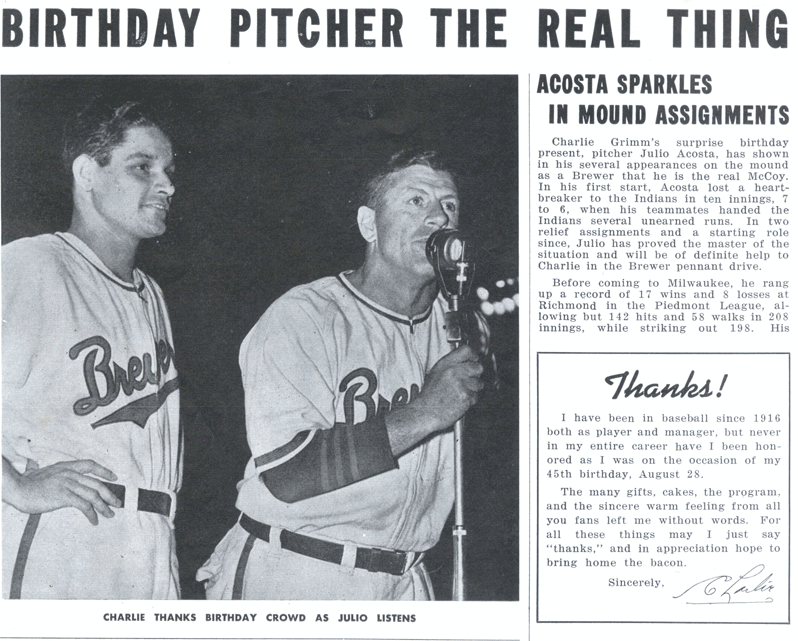
66 years ago today, in 1943, Milwaukee Brewers manager Charlie Grimm was celebrating his 45th birthday at Borchert Field, with a pregame ceremony before the Brews' contest against the Indianapolis Indians (among the fans in the stands for the festivities that night was a nine-year-old Brewerooter named Allan "Bud" Selig). No birthday party would be complete without presents, of course, and the birthday boy was showered with them, including a $1,000 war bond (from Bill Veeck, who promptly deducted it from Grimm's next check), a new left-handed banjo, and a rocking chair from the players, wiseacres all.

The best present, or at least the most flamboyant, would come with Veeck's signature on the card. At the end of the ceremony, a 15-foot cardboard cake was wheeled out to home plate. At a pre-arranged signal, a group of dancing girls burst out, followed by Julio Acosta, southpaw hurler formerly of the Norfolk Tars. Grimm had been lobbying for another starting pitcher for some time, and Veeck had secretly bought Acosta from the Piedmont League franchise for $7,500 (about 50% over the going rate) plus an extra $5,000 for the Tars to keep the deal secret. In fairness to Veeck, Grimm had been joking with the press a few weeks earlier, and when asked what he wanted for his birthday, he had replied "A left-hand pitcher".

Not one to be outdone by his boss's legendary sense of showmanship, Grimm started Acosta just minutes later. Acosta pitched well against Indianapolis, allowing only eight hits in his first six innings, but couldn't close it out. The Indians tied the game on an unearned run in the ninth and beat the Brewers on a home run in the tenth inning. Not the best ending to Jolly Cholly's birthday party, but still a pretty good present: Acosta would win his remaining three starts for Milwaukee.

This photo from the Brewer News shows Grimm and Acosta, fresh out of the cake and ready to take the mound:

Now that's a party.

Wednesday, August 26, 2009

A Tip of the (Baseball) Cap

Two months ago, the Brewers unveiled a monument at Miller Park honoring the 1901 Brewers, one of the inaugural American League franchises. The monument, commissioned by Watertown baseball historian David Stalker, reads:
In 1900, the American League was born at a Milwaukee hotel named the Republican House. The following year, during the 1901 inaugural season for the American League, the Milwaukee Brewers were one of eight teams to participate in Major League Baseball's "Junior Circuit." The Brewers played their home games at Lloyd Street Grounds, which was located on the city's north side (Lloyd Street and 16th Street). Player/Manager Hugh Duffy hit .302 that season and was later inducted into the National Baseball Hall of Fame. Wid Conroy was the team captain. Bill Reidy led the pitching staff with 16 wins, and John Anderson paced the team with a .330 batting average.

Five Wisconsin natives were members of that Brewers team, including Ed Bruyette of Manawa, Davy Jones of Cambria and George McBride of Milwaukee, all of whom made their Major League debut that year. Pitchers Pink Hawley of Beaver Dam and Pete Husting of Mayville also contributed. In 1902, the Brewers moved to St. Louis and became the Browns, but the league they helped form is still in existence today. After spending 52 years in St. Louis, the Browns moved to Baltimore in 1954 and became the Baltimore Orioles.
The back of the monument lists the roster:
John Anderson
George Bone
Ed Bruyette
Jimmy Burke
John Butler
Joe Conner
Wid Conroy
Jiggs Donahue
Pete Dowling
Hugh Duffy
Bill Friel
Ned Garvin
Phil Geier
Lou Gertenrich
Billy Gilbert
Bill Hallman
Pink Hawley
George Hogriever
Pete Histing
Davy Jones
Tom Leahy
Billy Maloney
George McBride
Bill Reidy
Tully Sparks
Irv Waldron
Although usually implied to be a one-year team (almost invariably credited as "the 1901 Milwaukee Brewers"), they actually played eight seasons, beginning in 1984. That club, as with the AL itself, had its origins in the minor Western League.

The Milwaukee club, seen here in its fifth year, was a founding member, along with teams in Detroit, Grand Rapids, Indianapolis, Kansas City, Minneapolis, Toledo and Sioux City.

Note the player seated in the front row, left side. Clark Griffith was a right-handed screwball pitcher then with the Brewers, his first professional team. In 1891, he jumped to the major league American Association (not related to the 20th century minor league), and would go on to pitch for the St. Louis Browns (now the Cardinals), Boston Reds, Chicago Orphans (Cubs), Chicago White Sox, New York Highlanders (Yankees), Cincinnati Reds and Washington Senators. Griffith would find his true home in Washington, first as a player, then a manager, then as the team's owner from 1920 until his death in 1955.

The Brewers would themselves move to the American Association for the latter part of 1891, after the Cincinnati Porkers dropped out of the league mid-season. Milwaukee stepped in to finish their schedule and amassed a 21-15 record, playing their home games in Borchert Field (then known as Athletic Park). Following that season, the American Association merged with the National League and the Brewers returned to the Western League, and the minors.

Having had a taste of the majors, the Brewers would work their way back. The Western League, not content with being a minor circuit, would change its name to the American League in 1900, and the following season would declare itself a major.

The AL would change the very nature of Organized Baseball, creating the two-league/World Series system we still enjoy today, but the Brewers wouldn't survive to see it. They moved to St. Louis before the 1902 season, taking on one of the hometown Cardinals' discarded nicknames (the Chicago entry would do the same thing, borrowing a bit of the older team's glory with the name "White Stockings"). As the Browns, the former Brewers set a standard for decades of mediocrity.

The void left in Milwaukee by the departure of the American League club was filled by two new minor league teams. The first was the Milwaukee Creams, which played in a new incarnation of the Western League (confused yet?), lasting only a few seasons before folding. The second took the by-now traditional name "Brewers." The Creams set up shop in the AL Brewers' former ballpark, Lloyd Street Grounds, forcing the Brews into Athletic Park, where they would be the most successful club Milwaukee had ever seen.

Aside from a shared birthplace, the Browns had something of a link with the Brews throughout their respective histories. The Browns owned the Brewers from 1932-1935, notable in that it represents the only exception to the American Association club's independent status until the Boston Braves purchased the club in 1949. In addition, they had in common "The P.T. Barnum of Baseball," Bill Veeck, as owner. After cutting his eye teeth (and perfecting his gags) in Milwaukee, Veeck's showmanship would reach full bloom in St. Louis. The Browns themselves even flirted with moving back to Milwaukee on several occassions before the Braves claimed the baseball-crazy town for their own. They settled for Baltimore, where they still play today as the current incarnation of the Orioles.

This recognition from the Brew Crew is a welcome addition to the public understanding of Milwaukee's rich baseball history, and a very classy move. The Braves so captured the public imagination that earlier clubs tend to be nudged out of the spotlight. The Brewers, to their credit, are working to change that.

Now we just need an exhibit dedicated to the Brews at Miller Park. Stalker has stepped up to the plate. Now it's our turn at bat....

Saturday, August 22, 2009

Don't Forget Your Jacket


Ebbets Field Flannels has long been the only source for classic Milwaukee Brewers merchandise. The Brews have been one of what I would consider the second tier of EFF's offerings; they consistently have several items available, a respectable variety but not quite in Seattle Rainiers or San Francisco Seals territory.

In addition to the jerseys and t-shirts, for several years in the 1990s Ebbets Field offered a beautiful 1949 Brewers jacket. Since discontinued, it featured a navy wool body and sleeves, red leather trim on the pockets, red and white knit trim, and proud block "M" on the chest. Royal blue shoulder inserts gave it a dynamic look.


I picked this one up for $40 on eBay some years ago (almost ten years after Ebbets Field took it out of production), where it was advertised as a "Memphis Red Sox jacket." The jacket had been sightly altered, with a diamond-shaped "Negro Leagues" tag sewn in the collar (visible in the photo under the original EFF tag). I don't know when it acquired this tag, but somebody at some point obviously believed that Negro League merchandise was more marketable. Given how cheaply I was able to buy it, the assumption might not have been correct.

I had never seen a period photo of this jacket, but the always-reliable Paul Tenpenny came through again:

(Photo courtesy Paul Tenpenny)

The model is Virgil Jester, right-handed pitcher in the Braves' organization. He spent 1951 and part of the 1952 season with Milwaukee, pitching the remainder of the 1952 season for the Boston Braves, where he garnered a 3-5 record and 3.33 ERA in 19 games. He was also a member of the Braves' inaugural 1953 season in Milwaukee, albeit briefly - he gave up 5 earned runs in 2 innings and earned a ticket back to the minors, where he ended his career in 1959.

It's a gorgeous jacket, and a worthy addition to our understanding of the Brewers' uniform æsthetic. I'm glad to finally own one, and hopefully we'll see its like again from Ebbets Field.

Sunday, August 16, 2009

Out On A Lin


One of the wonderful things about researching a team like the Brews is that you never know where inspiration will strike. Every treasure you find in an antique store or flea market, every reference gleaned from an old newspaper, can send you in search of another story.

I recently picked up this vintage 1934 photo of infielder Lin Storti on eBay. He piqued my interest - I had seen his name mentioned, often in connection with the 1936 pennant-winning season, but didn't know much about him. Long baseball career, but only a couple years as a reserve in the majors, and those were with a long-defunct club. Not the kind of player who attracts much attention seventy-five years later. He doesn't even have a Wikipedia entry.

Lindo Ivan Storti came to Milwaukee in 1934, right around the time that picture was taken, after having played parts of four seasons with the St. Louis Browns (the Browns owned the Brewers from 1933 through 1935). He stayed with the Brews until 1938, the longest stint in one place of his 16-year minor league career.

Moving to Milwaukee meant a regular spot at second base, and when given the opportunity to play on a daily basis Storti came through. He led the 1934 Brewers with a .330 average and an amazing 35 home runs, nine more than his closest teammate.

This production didn't go unnoticed. Storti soon attracted offers from other clubs. Having seen enough of Storti from the other dugout, the Minneapolis Millers made repeated overtures of $4,000 in cash to the Brewers. Milwaukee manager Al Sothoron wasn't interested:

Sothoron, who knew Storti from a brief managerial stint with the Browns in 1933, moved him from second base to third for his sophomore season with Milwaukee. The Millers continued to watch him from the opposing dugout, and raised their offer to $5,000 during the 1935 winter meetings:

Storti's "poorest season" was poor only by his own high standards. While not quite up to his 1934 production, his 29 home runs in 1935 was second only to Ted Gullic's 33, and miles ahead of Frank Doljack's third-place 9 dingers.

Sothoron's refusal to sell his third-bagger would pay off; the Brewers won the 1936 pennant by five games, their first in twenty-two years, clinching with what must have been a satisfying doubleheader sweep of the Millers. Storti got his share of the credit in the Milwaukee Sentinel's post-season retrospective:

Storti, for his own part, didn't exactly discourage offers from other teams. He was famous for sending back contract extensions when first offered.

He would eventually sign a new contract and continue his pace, hitting three home runs in a single game against the Columbus Red Birds.

Minneapolis eventually got their man. The Brewers sold his contract to the Millers on December 9, 1938, but his stay in the Twin Cities was to be short-lived, and he was sold to the Syracuse Chiefs of the International League during the 1941 season. Lin would finish out his career with a couple seasons kicking around the Pacific Coast League.

Like the famously maladroit Browns organization for which he played, Lin Storti has never received his due recognition. But, like the Browns, his story continues to intrigue those who remember. In 2006, his 1933 St. Louis jersey sold for $7500 at auction. Clearly, neither he nor his club have been completely forgotten, Wikipedia be damned.

Monday, August 3, 2009

One Slim Moment in Time

Perusing newspaper archives for another glimpse of the Brewers' short-lived "fancy M" uniforms, I found this exemplar in the March 27, 1936 edition of the Milwaukee Journal.

Very cool to see that uniform in action. But even more interesting is the story which surrounds the player wearing it, Jack Price (Slim) Hallett. From the accompanying article (click the picture above to read):
Lake Wales, Fla.—Skimming the cream of the crop of Milwaukee rookies, Harry Strohm, manager of the Clarksdale (Miss) club (Cotton States League), left here Friday morning for his home base with instructions to develop players for the 1937 Brewers. Two of the five are Jack (Slim) Hallett, a promising right handed pitcher, and Gordie Foth, Milwaukee sandlot shortstop. They accompanied Strohm to Clarksdale.
Although the Brewers were themselves a highest-level minor league club, what today we would call AAA, for most of the team's history they operated independently of any Major League baseball team, developing their own talent and maintaining their own farm system.

Hallett played high school ball in his native Toledo before being picked up by the Minneapolis Millers in 1933. He struggled to make the roster and was cut loose. Two years later, Milwaukee signed Hallett as a free agent and assigned him to the Crookston Pirates, the Brewers' Northern League affiliate in Crookston, Minnesota. In Hallett's single season as a Pirate, he went 9-14 with a 7.14 ERA.

He got a chance to join the Brewers as a reliever during the 1935 season, pitching but one single inning and giving up a statistically tidy 1 hit, 1 run and 1 walk. He, along with other rookies, was assigned to one of the Brewers' farm clubs for development. In Hallett's case, it was the top level of the Brewers' farm system, and expectations were high for the "promising right handed pitcher":
"(G)ive me Hallett for one season and I'll turn him back next spring ready for a regular job in the American Association," said Harry.
It didn't quite work out that way.

Hallett pitched seven games for the Clarksdale Ginners, amassing a 1-6 record with an ERA of 6.00 before finding himself sent down to the Fieldale (Virginia) Towlers in the Bi-State League (just as an aside: I love minor league team names). Hallett had a brief stint in Los Angeles with the Chicago Cubs organization before breaking into the Bigs with the Chicago White Sox.

Hallett played part of six seasons in the Major Leagues, with the White Sox, Pirates and Giants before retiring in 1949. Hallett retired to his native Toledo, where he died in 1982.

Funny how things work out - although nobody could have known it at the time, that one brief inning in 1935 would be Slim Hallett's entire career in a Milwaukee Brewer uniform. Fancy M or otherwise.

Monday, July 27, 2009

Bearing Down

This past Saturday, the Brewers held their fourth annual Negro League Tribute Night. As part of the festivities, the Crew wore throwback uniforms honoring the 1923 Milwaukee Bears, the Cream City's short-lived entry in the Negro National League.

The Bears were one of a pair of teams hastily created to fill the vacancies left in the NLL after the Cleveland Tate Stars and Pittsburgh Keystones folded after the 1922 season. Led by Hall of Fame player/manager Joseph Preston "Pete" Hill, who was personally chosen by NNL president Rube Foster. Hill found himself in charge of a team culled from the defunct NNL Pittsburgh Keystones, the independent (low-level) New Orleans Crescent Stars, and players who attended an open April tryout held in Chicago.

The Bears made their home at Athletic Park (as Borchert Field was known at the time), but never really found their footing in Milwaukee. Ignored by the mainstream press, and struggling in the face of stronger competition around the Negro National League, they failed to bring fans to the park. After only nine games at home, the Bears converted to a traveling club, playing the rest of their schedule on the road. Even that proved too daunting for the club, and after limping to a 12-41 record the Bears folded in September, with four weeks remaining in the NLL season.

Incidentally, the other team created to round off the NLL schedule, the Toledo Tigers, was even less successful than the Bears. The Tigers followed an almost-identical path, only quicker: they floundered at home, merged with an independent team from Cleveland, became a traveling club at the end of May and disbanded in mid-July. The Tigers players were the distributed to two other franchises in an effort to bolster them, one of the lucky recipients being... the Milwaukee Bears.

This one all-too-brief season was to be the extent of the Negro Leagues' tenure in Milwaukee. The Bears' owners were represented at the winter meetings later that year (and reportedly even participated in the league's revenue sharing), but they never fielded another club in the Cream City, and no other owners ever stepped forward to try their hand.

What's particularly interesting to me is that there is so little actual information available about the Bears. Contemporary records are spotty, not surprising considering the poor treatment they received from the press. There's a new traveling exhibit devoted to the Negro Leagues making its way through the Milwaukee Public Library system. Reportedly, the MPL is lending some of its own collection on the Bears - anybody in Milwaukee able to attend, maybe take some pictures?

Though the Milwaukee Bears failed to gain traction during that short 1923 season, they continue to fire the imagination of the game's students, and have always been well-represented in Turn Back the Clock events. The uniforms worn during those games, however, is an interesting story. For a team which played only part of one season, the Bears have an amazing variety of throwbacks out there.

The first Bears throwback of which I am aware was worn by the Brewers in the 2001 Annual Negro League Tribute Game in Detroit. The Tigers wore Detroit Stars uniforms, and the Brewers wore these:

Starting in 2006, the Brewers made Negro League tribute games (and with them, Bears throwbacks) an annual event. New throwback uniforms were unveiled, completely different from those of five years earlier, in a sharp black-and-white color scheme. The caps were pinstriped white with a solid black M. They jerseys featured matching black pinstripes and "MILWAUKEE" across the chest.

Replica jerseys were sold at Miller Park, and a cap was given away to fans.

The Brewers also wore a road gray version of that uniform on a trip to Kansas City on June 24th of that year.

Those were the "official" Milwaukee Bears throwbacks through the 2008 season.

For 2009, the throwbacks have been redesigned, bearing (if you'll forgive me) a stronger resemblance to the one that's been commercially available for the last few years, with vivid blue sleeves and accents on the pants.

I absolutely love the cap logo. Simple yet distinctive.

Hope they make these available for sale.

So now we have a third throwback Milwaukee Bears uniform. At least two distinctive looks, if the pinstriped grays are the road version of the home uniform they wore on Saturday. For a team which failed to complete even a single season, that's pretty impressive. Moreover, it's pretty unlikely.

So which was it? Black and white or blue and orange? What was the justification for moving away from blue and orange to black pinstripes, and now what's the justification for jumping back?

I would love to hear from some Negro National League scholars about the historical accuracy of any of these uniforms. Is any one of them an accurate reflection of what the Bears wore in 1923, or are they all simply guesses (educated, wild or otherwise)?

I'm glad that the Bears are getting so much attention from the current Brewers. I do wish that the club would give their namesake a little of this recognition, however. It's been over a decade since the Brewers wore throwbacks honoring the city's American Association heritage. Since then, it's been all Milwaukee Braves and Milwaukee Bears throwbacks, with the "Milwaukee Cerveceros" thrown in for good measure. Yet the Brews, a baseball institution for half a century, the foundation of Milwaukee's major league success, continues to go unsung.

We Brews fans need to be stronger advocates for the old club.

It's not as though the Brews didn't have many beautiful uniforms from which the Brew Crew might choose. I'd favor either of the home uniforms from Bill Veeck's time with the club, the block letter M:

or the elegant script "Brewers":

There are even a few options should they wish to merge it with the customary Milwaukee Braves throwback game against Atlanta:

I'd go to that game.

Wednesday, July 15, 2009

The Brews Break the Color Barrier

On July 15th, 1950, exactly three years and three months after Jackie Robinson made history at Ebbets Field in Brooklyn, the Milwaukee Brewers announced that they had signed their first black player, a first baseman named Leonard Pearson:

Like so many other black "rookies" of the time, Pearson joined Organized Baseball relatively late in life, after a long career in the Negro Leagues. He was a full decade older than the other rookies on the squad. He was, unfortunately, past his prime, and struggled in Milwaukee.

Shortly afterwards, the Brews picked up James Buster (Buzz) Clarkson to play at third. Like Pearson, he had already had a long career in the Negro Leagues. But even at the age of 35, Clarkson was an essential part of the powerhouse Milwaukee club. A third black player - George Crowe, a high school basketball star in his native Indiana - soon joined the club, and the 1951 Brewers would take the field with three black players.

Scan from 1951 Brewer yearbook. Courtesy Paul Tenpenny.

The Brewers weren't the only American Association club to sign black players. There were seven in the Association by the Spring of 1951; the three Brewers, three in Minneapolis (including a rookie named Willie Mays) and one in St Paul, so many that it warranted mention in the St. Petersburg Times. Not on the sports page, of course, but in a section called "News of the Negro Community":

Those 1951 Brewers took the American Association by storm, winning their first pennant since 1945, and then their first Junior World Series since 1936. Leonard Peason, on the other hand, continued to struggle. He went 1-for-9 in five games in 1951 before he was sent down to the Hartford Chiefs. Two years later, he was out of organized ball.

Buzz Clarkson was more successful, hitting .343 as . He was rewarded with a callup, joining the Braves in April of 1952. Unfortunately, Boston proved impatient with black rookies, and Clarkson was scarcely given a chance to prove himself. After only six games, in which he went 5-for-25, the Braves sent him back to Milwaukee. Reunited with the Brews, Clarkson hit .318 with 12 home runs in 74 games as the team rolled to an astounding 101 wins and a second consecutive American Association pennant. The next season, he fell to AA Dallas. After leaving the Braves organization, he plaed for the Los Angeles Angels, then the Chicago Cubs' Pacific Coast League affiliate, but never again saw The Show.

George Crowe had the best career of all three, starting with a .339 batting average and 24 home runs for Milwaukee during that 1951 season, and earning the league's Rookie of the Year honors:

He was hitting .351 for the Brewers in 1952 before being sent to Boston. His play was good enough to keep him in the Bigs, and when he moved back to Milwaukee it was with the rest of the Braves.

Crowe did have one more stint in the minors, spending most of the 1954 season at Milwaukee's new AAA club in Toledo (ironically enough, the displaced Brewers, which had become the Toledo Sox in the spring of 1953) before returning to the big leagues for good in 1955.

The Braves traded Crowe to Cincinnati in 1956, and as a Red he made the All-Star team in 1958. This honor was bestowed on him by baseball's players, managers and coaches, fans having lost the vote the year before in a ballot box-stuffing scandal (ironically enough involving the Reds). The Reds traded him to the Cardinals in 1959, and Crowe finished out his career with three years in St. Louis.

One has to wonder if Pearson and Clarkson would have been able to carve out similar major league careers had they been allowed to join the Brewers in their 20s instead of their 30s.