Showing posts with label on this date. Show all posts

Friday, April 29, 2016

Forget the Groceries, It's Time for Baseball!

On this day eighty years ago, the Brewers were preparing for their Home Opener at Borchert Field. And the city of Milwaukee turned out, as seen by this grocery store sign.

The Brewers, despite injuries and a batting slump, arrived home Wednesday in fourth place and Milwaukee began to prepare for the opening game Friday. Signs like the one shown above at Herman Militzer's grocery, 4303 W. Vliet St., blossomed out. Some factories also will let as many employees as possible attend the opener. (Journal Staff Photo)
I love it:

"NO DELIVERY OF GROCERIES FRIDAY AFTERNOON - BASEBALL OPENING"

In addition to grocery clerks and factory workers getting time off, Milwaukee school superintendent Milton C. Potter agreed to let high school students out of class early so they could make their way to the Orchard for Opening Day.

Sunday, September 29, 2013

This weekend in 1913 - "It's All Over but the Shouting, and That is Still Going On"

Yesterday we saw how five thousand fans crowded in front of the Sentinel building in downtown Milwaukee to hear Brewer play-by-play related to them via wore (and megaphone). The Brewers were in Louisville with an opportunity to clinch their first American Association pennant.

So how'd the Brews do? Remember, they needed to win at least one game from the Colonels and have the Minneapolis Millers lose one. The Millers obliged, dropping the first game of their double-header in Columbus, 13-3, while the Brewers' first game was still in progress. Now it was up to third baseman/manager Harry "Pep" Clark and his boys.

The Brewers opened the game showing some of the strain they had been under for months. The Milwaukee Journal told its readers that "lines of anxiety marked every (player's) face and for a time it looked as though the team would break under the strain." The usually sure-handed shortstop Lena Blackbourne booted an easy grounder in the top of the first, allowing a Colonel to advance into scoring position. Fortunately Milwaukee had ace Cy Slapnicka on the mound, and he was able to pitch himself out of the jam with a well-timed strikeout.

After that shaky start, the Brewers started to take over. Even the ball started bouncing their way; when a Louisville drive lined right off Slap's leg in the third, not only was the hurler unscathed but Pep Clark was able to snag the ricochet in time to nail the runner at first.  The Brewers and Colonels remained scoreless through the first five frames. 

The "Clarksmen" were aggressive on the basepaths - they had three runners caught stealing in the first five innings - and the strategy finally paid off in the sixth for the game's first run. With two outs and nobody on, Blackbourne managed to draw a walk and then went to work. He stole second base on the next pitch and moved to third when the Louisville catcher's throw to second bounded into center field. Blackbourne stood 90 feet from a Brewer lead when first baseman Tom Jones strode to the plate. The "big Welshman" took a mighty swing at a pitch from Lousiville's Grover Loudermilk, but he got over the ball. His line drive went almost straight down, striking the turf just in front of the plate and bouncing high in the air. Jones was off running, and by the time Loudermilk could get a handle on the ball his throw to first was late. Blackbourne scored in the confusion, and the Brewers were on the board. 

They followed it up with two more runs in the top of the ninth.  Even though the Colonels managed to plate a run in the bottom frame, it wasn't enough. The Brewers had won their first pennant. 

Milwaukee players sprinted out of the dugout and embraced on the field, yelling and waving to the small but noisy handful of Brewer fans who had made the four hundred-mile trip down from the Cream City.  As they celebrated, Brewer backstop "Doc" Marshall yelled up to the press box "Tell 'em up in Milwaukee to get that pole!"

The Kentucky fans were gracious in defeat, glad at least that their rivals in Minneapolis were denied the crown. The home fans gave the visitors a round of applause "in true southern style".

There was another game to play, but the Brewers didn't seem all that interested in the second half of the day's double-header, and when the game was called on account of darkness after five½ innings the Colonels had taken it 3-0. Here are the box scores for the two games: No matter about that second game; the Brews had what they came for.

The following morning, the Sentinel splashed its congratulations across the top of the front page:

It's a little busy, with the players' faces threatening to obscure the word "CHAMPIONS", but I think the paper could be excused its enthusiasm. The "Py Golly" character in the middle is an interesting one. He seems to have been cartoonist Cad Brand's own mascot for the club, a Scandanavian-accented booster who chronicled the team's story in the pages of the Sentinel.

Much of the credit for the pennant was laid at the feet of Pep Clark. Although 1913 was his first campaign in the double player/manager role, he had been Milwaukee's third baseman since 1904 and was well-liked throughout the league. When he came up to bat for the first time in that darkness-shortened second game with Louisville, the home fans gave him a round of applause. Pep responded by tipping his cap, the gentleman.

His graciousness was also on display the following day, in a Sentinel piece appearing under his name. Playing off his nickname, the article was entitled "Pep and Energy Won, Says Clark:
Pep and determination won the pennant. The boys certainly deserve all the credit in the world. They're the gamest bunch of fellows I ever played with. They never knew when they were beaten.

When Minneapolis passed us two weeks ago not a man on the team lost hope. They battled all the harder, battled their way back into the lead and on Sunday nailed the flag to the pole.

It was a tough fight and I am glad it is over. Now that we have the pennant I might as well confess that I have slept hardly a wink in the last week. After that 20 to 10 reverse in Indianapolis on Friday you could have cut the gloom with a cheeseknife. I was down in the mouth and so was the whole bunch.

But we went back full of confidence on Saturday and we won. We all felt better after that, but were all on edge when we started that first game Sunday afternoon. It wore off as the game progressed and after we scored that run in the sixth inning I don't believe I ever felt happier or more confident in my life. It also put new life in the boys, they were in there to battle for every inch and they certainly came through in fine style.

I had a good ball club all season. We had a lot of bad luck or I believe we would have had the flag clinched a week ago. My pitching was strong, the club was a hard hitting one, while in the field it played great ball.

This combination and an iron bound fighting determination to fight all the way made for a championship club.

Now for a pennant in 1914.
Brave words from the Brewer skipper, but also an acknowledgment that the pressures of the season had been weighing on the club.

That evening, reporters found pitcher Joe Hovlik in the hotel lobby. Between puffs of his Havana, Hovlik echoed Clark's relief. Well, he told them, I'll get a decent night's sleep now, and believe me it will be the first one I have had in two weeks."

The next day, the Brewers would finish the season with another twin-bill before heading back to Milwaukee and their fans. Banquets had already been planned, and a grateful city was eager to welcome back her heroes.

A post-season series was scheduled between the Brewers and the Denver Grizzlies, champions of the Western League, for bragging rights over all the minor leagues. But that was all to come. For now, it was time for celebration and sleep, although perhaps not in equal amounts. Milwaukee was a championship town.

Saturday, July 16, 2011

Mantle in Milwaukee - 60 Years Ago

by Paul Heinz

Sixty years ago this July 16, on a warm, foggy evening, a small crowd of 3400 came to watch the Brewers host the Kansas City Blues, both teams tied for second place in the American Association league. Fans that night couldn’t have known they were about to witness a glimpse of future hall-of-fame greatness. It happened to be the first minor league appearance that season for a 19 year-old from Oklahoma who’d been wearing pinstripes just days before.

Mickey Mantle had struggled for the previous month as a New York Yankee, his average sinking to .260, and it was decided that he should regain his swing in Kansas City. When Yankee manager Casey Stengel told Mantle privately of the decision, Mantle cried.

Days later in Milwaukee, the fog was so thick, Mantle quipped, "I may need a mask out there tonight."

That evening, the switch-hitter batted lefthanded and went 1 for 4, his only hit a bunt single to the first-base side. Those in attendance got to witness Mantle at his blazing best: among the fastest to ever play the game (it's been said that Mantle ran from home to first in 3.1 seconds when batting from the left side).

The following evening, after word had spread that Mantle was in Milwaukee (both the Sentinel and the Journal had highlighted Mantle's appearance), the crowd swelled to over 10,000, and Mantle went 0-4. In fact, he played so poorly for the next couple of weeks, he considered quitting baseball altogether. Luckily for baseball, he didn’t. And luckily for the Brewers, by the time they faced the Blues again, Mantle was already back up in the majors, having hit .361 with 11 home runs and 50 RBIs during his six week stint in the minors. He was never to return.

And as fate would have it, he was just a month away from an injury that would rob him of his full potential.

That October, during game 2 of the '51 World Series against the Giants (who'd made it there after Bobby Thompson's "Shot Heard 'Round the World") Mantle caught his spikes in a drain in right field while trying to avoid a collision with Joe DiMaggio, on a ball hit by another celebrated rookie, Willie Mays. It was an amazing convergence of three of the game's best, a linkage of the past with the future. The play would also link Mantle's past with his future; he blew out his knee, and would never run the base paths again without pain.

Although Mantle's injury may have kept him from realizing his full potential, it didn't keep him from achieving greatness: he would go on to win three MVP awards and seven World Series titles.

As for Milwaukee, the Brewers and Borchert field gave way to the Braves and County Stadium in 1953, but Mantle would return to The Cream City again in 1955 as a Yankee All-Star, almost four years to the day of his appearance at Borchert Field. Mantle wasted no time getting the American League on the board, hitting a three run home-run in the first inning. In his next game in Milwaukee, he hit yet another home run, this time in game 3 of the ‘57 World Series, a 12-3 whooping for the Yankees over the Braves.

For those in attendance that fall day at County Stadium, perhaps a handful could remember seeing Mantle six years earlier, when he was a struggling ballplayer with lightning speed and limitless potential. A potential, it would appear, that was now fully realized.

1951 Kansas City Blues (Mickey Mantle is 2nd row, 3rd from right)


Paul Heinz is a musician and writer who's completed seven CDs of original songs, mostly in the rock/pop vein, and he's putting the finishing touches on pop CD for teenage singer, Maddy Meyer. He writes a weekly blog, his essays have aired on 89.7 WUWM in Milwaukee, he won the 2006 James Jones Short Story award, and he's on the hunt for an agent to represent one of his two completed novels. All of his music and essays can be found at www.paulheinz.com. Paul is currently playing keyboards for the fabulous rock and soul band, The Chi-Town Showstoppers. Go to www.chi-townshowstoppers.com for more information.

Saturday, July 31, 2010

Good Godfrey! "A Most Fearsome Man" at the Orchard

By Pete Ehrmann


Editor's Note: Today our resident boxing expert brings us the story of a very unusual match which took place at the Orchard exactly seventy-nine years ago, on July 31st, 1931.

George Godfrey

George Godfrey possessed every attribute necessary to become heavyweight champion of the world except the proper skin tone. So even though he beat plenty of other contenders, he never got the chance to fight for the big enchilada himself because after Jack Johnson the people running boxing weren't about to go through that again.

Johnson, the first African-American to win the title, reigned from 1908-'15, and was hated for that, for the ease with which he bowled over the White Hopes sent up against him, plus his very public fondness for fast cars and white women.

John L. Sullivan, the first modern-era heavyweight champ, was a drunken blowhard, but that didn't bother many back when the heavyweight champion of the world was as exalted a figure as the President of the United States. It was considered a sign of Sullivan's true moral character that he refused to risk his title against black Australian Peter Jackson, and when his successors also drew the "color line" against black contenders they were cheered for it as fervently as Tommy Burns was condemned for fighting Johnson and losing to him.

After Jess Willard unhorsed Johnson in 1915, the heavyweight championship of the world was again made off-limits to black fighters for another 22 years.

Shut out of title consideration, they had their own "colored championship," and in the late 1920s it belonged to George Godfrey.

"He was a legendary fighter, a most fearsome man," wrote Larry Gains, another famed black fighter of that time. "With the possible exception of (Jack) Dempsey, he was the best and most destructive heavyweight in the world. He was so powerful that he didn't just beat men, he ruined them. It came to the point where no white man would fight him, unless the handcuffs were on."

The handcuffs were on in 1930 when the 6'4", 230-pound Godfrey was matched with Primo Carnera, the Italian giant being steered to the world title by his mobster handlers in a series of blatantly fixed fights. In the February, 1948 issue of Sport magazine, Jack Sher wrote that Godfrey "had a terrible time losing to Primo. It was almost impossible for this boy to fight badly enough for the huge Italian even to hit him! He finally solved the dilemma by fouling Primo in the fifth round.

"After the fight, several suspicious reporters came into Godfrey's dressing room and began to ask how hard Primo could hit. 'Hit?' the large Negro grinned, 'That fellow couldn't hurt my baby sister.' The reporters began to laugh and then into the room walked several of the gentlefolk" — mobsters — "who were handling Carnera. Godfrey's face changed. 'That white boy sure has some punch,' Big George said quickly. 'I thought the house had fallen in on me a couple times there.'"


Whether Godfrey was the "colored heavyweight champion" when he stepped into the ring at Borchert Field on July 31, 1931 isn't certain. It didn't make any difference, though, because he wasn't wearing boxing gloves. Tired of the runaround he got in boxing, Big George was now a wrestler.

Wrestling was popular in Milwaukee, and the reigning local idol and Godfey's opponent at Borchert Field was Ernst "Ernie" Scharpegge, about 6'4" and 230 pounds, whose losing match against heavyweight champion Gus Sonnenberg a year earlier had sold out the Auditorium.

Ernie Scharpegge

About 1,500 fans were at Borchert Field for what the Wisconsin News called "one of the worst, and yet one of the most exciting, grin and grunt affairs in Milwaukee."

On the eve of the match it sounded like Big George wasn't quite reconciled to his new profession.

"There is nothing that would suit me better than to have one of those big beef artists use the wrestling holds and let me punch him full of holes," he told the Wisconsin News.

But when the match started he managed to refrain from reverting to old habits. After 10 minutes of grappling, Scharpegge won the first fall with a crotch hold and body slam.

When the best two-out-of-three falls match resumed, it was Scharpegge who resorted to fisticuffs after Godfrey got him in a strangle hold, punching George in the stomach and chin. Godfrey retaliated with a right that sent Scharpegge to the mat.

At that point, more than 12 uniformed policemen rushed into the ring and surrounded Godfrey. As the bell rang and the crowd started to boo, "It looked like the start of riot," reported Ronald McIntyre of the Milwaukee Sentinel.

But then Scharpegge and Godfrey shook hands and the match resumed. Within moments, Scharpegge took another swing at Godfrey, and when the referee objected he took a swing at him. The cops rushed back into the ring, and Scharpegge took a few of them on, too.

The result was a win by disqualification for Godfrey ("whose forbearance," wrote "English 'Arry" in the Wisconsin News, "proved that a white heart beats beneath an ebony exterior"), and a column in the Milwaukee Sentinel the next day by Ronald McIntyre blasting promoter Tom Andrews for making the "sad mistake" of pitting a white man against a black man in the ring.

"He might have known that the chances were about 10 to 1 it would end up the way it did -- in a near riot," wrote McIntyre, who oddly blamed Godfrey even though Scharpegge tossed the first punch.

"If Andrews had stopped to consider the possibilities of a Godfrey-Scharpegge match, he might have realized its shortcomings. In the first place, Godfrey cannot wrestle, and in the second place, he cannot get away with the rough tactics Scharpegge might get away with in a match with a Sonnenberg or a McCoy.

"Because he knew little or nothing about wrestling holds, Godfrey had a stranglehold on Scharpegge's Adam's apple most of the time after the first fall. This goaded Ernst into action and he got rough… When the punching started, Godfrey might just as well have quit for he realized that if he started slugging, a race riot might have ensued."


From the Milwaukee Sentinel, August 1, 1931

Since apparently he was going to get belted in the ring no matter what, Godfrey returned to boxing. In 1935, he even won recognition as heavyweight champion by an obscure European outfit called the International Boxing Union.

"Godfrey has had a remarkable career," wrote columnist John Lardner. "Like most negroes who devote their spare time to fisticuffs, he has been a magnificent but erratic fighter. If I had George in his prime, and were sure that he meant business, I would back him to beat the Joe Louis of today. He was bigger, faster and wiser than Louis, and he carried a knockout punch in both hands.

"But George was an employee at heart. When the evening's program called for him to lose by foul, knockout, or decision, he did so. He was satisfied to do so, provided he received his ration of pork chops after the entertainment. George made a bum out of our national pork supply. He also made a bum out of himself."


That was a pretty harsh judgment about a fighter whose race and not his appetite rendered him "an employee at heart." Harsher still was the end for Big George. At age 50, he "died in poverty in his dingy little room" in Los Angeles on August 13, 1947, reported the Associated Press, "with only his large black dog by his side."

Thursday, April 15, 2010

Playing in the Snow at Athletic Park

by Dennis Pajot

Eighty-nine years ago today, on Friday, April 15, 1921, the Milwaukee Brewers and St. Paul Saints appeared at Milwaukee’s Athletic Park at 8th and Chambers to play a game of baseball. Only 176 paying customers were in the park to watch the game. The majority of these were huddled in the east grandstand seats, to keep warm in the 20 degree weather, made worse by a frigid April wind. The Milwaukee Journal reported only 10 spectators were in the bleachers. To add to this, Milwaukee was in the beginning of one of the worst blizzards it could remember.

The next morning the Milwaukee Sentinel wondered if Brewer owner Otto Borchert was "planning to start a league among the Eskimos with Nome, Klondike, Frozen Dog and other Arctic points in the circuit." But, indeed, "an alleged game of baseball" took place. The paper thought that just the fact the game made it nine innings was "one for the book." The Sentinel's Manning Vaughan wrote the game was played "regardless of the health of high priced athletes and utter regardless of the poor down-trodden newspaper scribe."

It was reported that by the third inning the diamond was so thoroughly blanketed by snow that batted balls had to be dug out of the snow. All that was needed to make it a most festive occasion were "some sleigh bells and some mistletoes to have over Otto’s curly head." The paper's editors helped in this respect with a Christmas motif, when giving the score.

Milwaukee Sentinel—April 16, 1921

The game turned out to be a burlesque affair, with rain, hail and snow falling throughout the game. Running around in mud up to the player’s shoe tops, the Brewers won the game 7 to 4. Milwaukee’s "Unser Choe" Hauser went 4 for 4, and rookie pitcher Ray Lingrel relieved starter Nemo Gearin in the fourth inning, pitching scoreless ball and was credited with the win. About only 50 spectators were around at the end of the game.

The day after the game the Evening Sentinel was in a less jovial mood than the other Milwaukee newspapers:
There was absolutely no excuse for playing the game. There was about one hundred and fifty fans in the stands at game time, and they yelled "play ball" so loudly that it was finally decided to start. The job was then up to the umpires. They could have stopped it any time after the first ball was pitched, and they would not have been violating any rules.
The evening paper went on to say the St. Paul newspapermen said they had never seen a game played under such conditions, and the editor of the Milwaukee paper agreed. How bad were the playing conditions? According to a report years later every time a ball hit the oozy clay surrounding home plate it stuck tight and had to taken out of play. A St. Paul runner was thrown out at home when he became mired in the mud between third and home.

Milwaukee, indeed, was walloped with a snow storm that day and into the next. Nearly 15 inches of snow fell in 27 hours. 40 miles per hour winds caused drifts of ten feet. The newspapers reported the city was almost isolated from the rest of the world by the "most terrific blizzard in the history of the city." Within the city streetcars and trains were stalled, while streets were completely blocked by high drifts. Early reports placed damage in the millions of dollars.

A few years later an account of what happened was given in the Milwaukee Journal. Before the game umpires Bill Finneran and Buck Freeman called Otto Borchert to their dressing room and suggested he call the game off. Borchert’s reply was: "I'll call off games when I want to. Your job is to umpire. Now get out there and go to work." The game started at 3:05, five minutes late.

The Saints scored three runs off Gearin in the top of the first inning, and Borchert yelled down to the umpires from the press box: "Call off the game! I can’t see the ball!" Finneran yelled back: "You wanted to play a few minutes ago when we asked you to postpone the game. You told us that our job was to umpire. Well, that’s what we’re doing." In the 1939 obituary for Nick Allen, who caught for St. Paul that day, it was reported by the third inning the fielders could not follow the flight of the ball. Allen pleaded with the umpire to call off the game before someone got hurt. The umpire told him "Borchert insisted that we start the game despite the threatening weather. I'll go through with this no matter what happens to you guys."

The Brewers scored six runs in the bottom of the fourth inning—reportedly aided by the Saints' difficulty in finding the ball—to take a 6 to 4 lead and umpire Finneran asked the Brewer owner: "Do you want the game called off now?" Borchert roared back: "You'll finish this game if it’s the last thing you do." The Brewers scored one more run in the seventh to conclude the scoring. By the end of the game all the players except the pitchers were wearing their sweater coats.

As the snow continued, the next day's game—plus the entire next series with the Minneapolis Millers—would be cancelled. But the St. Paul players played another game the day after the "snowball game." All day they telephoned the Brewer office, asking "Will there be a ball game today?"


SOURCES

Milwaukee Journal April 15, 1921, May 3, 1935, October 18, 1939, April 4, 1971
Milwaukee Sentinel April 16, 17, 1921
Milwaukee Evening Sentinel April 16, 1921
Milwaukee Journal Sentinel June 7, 1998

Wednesday, September 16, 2009

One Hundred Years Ago Today...

There's a fascinating project underway at The American Association Almanac. Rex Hamann is chronicling the 1909 pennant race with a "This Day in History" format, providing box scores and game recaps from a century ago.

In the summer of 1909, the Milwaukee Brewers were locked in a tight race the Minneapolis Millers and Louisville Colonels. On September 11th, with three weeks to play, the Brewers had a three game lead over the Millers. Since then, it's been tightening up.

Even though we know how the story ends (I'm not going to spoil it here), it's a fascinating tale and a tremendously ambitious research project. Thanks, Rex!

Friday, August 28, 2009

Happy Birthday, Charlie

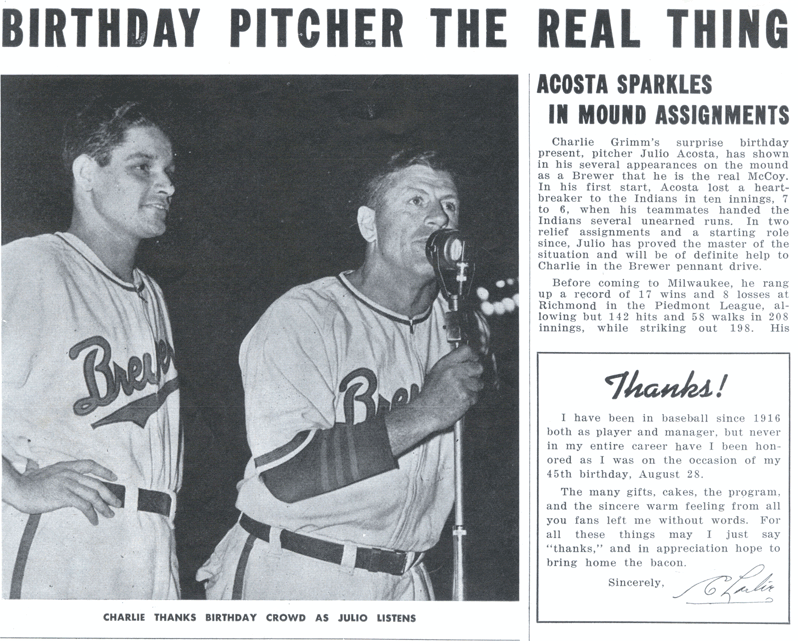
66 years ago today, in 1943, Milwaukee Brewers manager Charlie Grimm was celebrating his 45th birthday at Borchert Field, with a pregame ceremony before the Brews' contest against the Indianapolis Indians (among the fans in the stands for the festivities that night was a nine-year-old Brewerooter named Allan "Bud" Selig). No birthday party would be complete without presents, of course, and the birthday boy was showered with them, including a $1,000 war bond (from Bill Veeck, who promptly deducted it from Grimm's next check), a new left-handed banjo, and a rocking chair from the players, wiseacres all.

The best present, or at least the most flamboyant, would come with Veeck's signature on the card. At the end of the ceremony, a 15-foot cardboard cake was wheeled out to home plate. At a pre-arranged signal, a group of dancing girls burst out, followed by Julio Acosta, southpaw hurler formerly of the Norfolk Tars. Grimm had been lobbying for another starting pitcher for some time, and Veeck had secretly bought Acosta from the Piedmont League franchise for $7,500 (about 50% over the going rate) plus an extra $5,000 for the Tars to keep the deal secret. In fairness to Veeck, Grimm had been joking with the press a few weeks earlier, and when asked what he wanted for his birthday, he had replied "A left-hand pitcher".

Not one to be outdone by his boss's legendary sense of showmanship, Grimm started Acosta just minutes later. Acosta pitched well against Indianapolis, allowing only eight hits in his first six innings, but couldn't close it out. The Indians tied the game on an unearned run in the ninth and beat the Brewers on a home run in the tenth inning. Not the best ending to Jolly Cholly's birthday party, but still a pretty good present: Acosta would win his remaining three starts for Milwaukee.

This photo from the Brewer News shows Grimm and Acosta, fresh out of the cake and ready to take the mound:

Now that's a party.

Wednesday, July 15, 2009

The Brews Break the Color Barrier

On July 15th, 1950, exactly three years and three months after Jackie Robinson made history at Ebbets Field in Brooklyn, the Milwaukee Brewers announced that they had signed their first black player, a first baseman named Leonard Pearson:

Like so many other black "rookies" of the time, Pearson joined Organized Baseball relatively late in life, after a long career in the Negro Leagues. He was a full decade older than the other rookies on the squad. He was, unfortunately, past his prime, and struggled in Milwaukee.

Shortly afterwards, the Brews picked up James Buster (Buzz) Clarkson to play at third. Like Pearson, he had already had a long career in the Negro Leagues. But even at the age of 35, Clarkson was an essential part of the powerhouse Milwaukee club. A third black player - George Crowe, a high school basketball star in his native Indiana - soon joined the club, and the 1951 Brewers would take the field with three black players.

Scan from 1951 Brewer yearbook. Courtesy Paul Tenpenny.

The Brewers weren't the only American Association club to sign black players. There were seven in the Association by the Spring of 1951; the three Brewers, three in Minneapolis (including a rookie named Willie Mays) and one in St Paul, so many that it warranted mention in the St. Petersburg Times. Not on the sports page, of course, but in a section called "News of the Negro Community":

Those 1951 Brewers took the American Association by storm, winning their first pennant since 1945, and then their first Junior World Series since 1936. Leonard Peason, on the other hand, continued to struggle. He went 1-for-9 in five games in 1951 before he was sent down to the Hartford Chiefs. Two years later, he was out of organized ball.

Buzz Clarkson was more successful, hitting .343 as . He was rewarded with a callup, joining the Braves in April of 1952. Unfortunately, Boston proved impatient with black rookies, and Clarkson was scarcely given a chance to prove himself. After only six games, in which he went 5-for-25, the Braves sent him back to Milwaukee. Reunited with the Brews, Clarkson hit .318 with 12 home runs in 74 games as the team rolled to an astounding 101 wins and a second consecutive American Association pennant. The next season, he fell to AA Dallas. After leaving the Braves organization, he plaed for the Los Angeles Angels, then the Chicago Cubs' Pacific Coast League affiliate, but never again saw The Show.

George Crowe had the best career of all three, starting with a .339 batting average and 24 home runs for Milwaukee during that 1951 season, and earning the league's Rookie of the Year honors:

He was hitting .351 for the Brewers in 1952 before being sent to Boston. His play was good enough to keep him in the Bigs, and when he moved back to Milwaukee it was with the rest of the Braves.

Crowe did have one more stint in the minors, spending most of the 1954 season at Milwaukee's new AAA club in Toledo (ironically enough, the displaced Brewers, which had become the Toledo Sox in the spring of 1953) before returning to the big leagues for good in 1955.

The Braves traded Crowe to Cincinnati in 1956, and as a Red he made the All-Star team in 1958. This honor was bestowed on him by baseball's players, managers and coaches, fans having lost the vote the year before in a ballot box-stuffing scandal (ironically enough involving the Reds). The Reds traded him to the Cardinals in 1959, and Crowe finished out his career with three years in St. Louis.

One has to wonder if Pearson and Clarkson would have been able to carve out similar major league careers had they been allowed to join the Brewers in their 20s instead of their 30s.