Friday, April 19, 2013

This Week in 1913: "Here's the Line-Up for the Season"

Just one week into recapping 1913's baseball season, I'm going to change the format a bit. I had originally thought a week-by-week summary might be a good idea, but that seems a bit limiting. Instead of working on a set schedule, I will instead post on an irregular one, with at least one new post a week (in the "On This Day" or "In This Week" format whenever possible). That will allow us to supplement the longer recaps with quick looks like this full-page ad, which ran in the Milwaukee Journal on Sunday April 13, 1913:

It's a tidy promotion for both the Brewers and local businesses, who together will "Put Milwaukee in First Place."

For each man, a matching ad; "Get Your 'Phil" at Kalt's Restaurants" for second baseman Phil Lewis, "Spring Suits That will Catch Your Eye" for backstop Johnny Hughes. I particularly like equating Cross Safety Razor's "Close Shave" with pitcher "Doc" Watson. There are some real groaners, though, including pairing catcher Jimmy Block with the slogan "Don't Let Anything Block You From Coming Here for Your New Spring Suit", and especially the ad in the center, featuring player/manager Harry "Pep" Clark and slogan "You Can't Retire Harry Clark—and You Won't Have to Re-Tire Your Auto—If You Equip Your Tires with American Tire Protectors".

  Note also the ad for the Harley Davidson motorcycles, then a mere decade old, featuring right fielder Newt Randall (because "You'll Be In the Right Field When You Ride a Harley-Davidson").

Sadly, the photograph of Randall (and his dog?) wasn't reproduced very well for the archives, but the ad copy is loud, clear and sublime:
The silent Gray Fellow with the Ful-Floating Seat and Free Wheel Control, and made in Milwaukee. More Harley-Davidson motorcycles sold in Milwaukee than all other makes combined. There are reasons. Call here and we will tell you all the reasons why, and you'll be convinced that it is the motorcycle for you to buy.
Who could resist such an entreaty? It's a hundred years later, and I still want to hear all their reasons why.


There's another ad I find equally interesting, this time for its connection with the Brews.

Dewey's Sporting Goods proudly proclaims that they made the Brewers' uniforms. The one example of a jersey we have from that season bears in its collar the tag of a P. Goldsmith and Sons of Cincinnati, Ohio. Perhaps that jersey was sold to the Brews by Dewey's, or was a re-purposed jersey from an earlier season.

As for Dewey's itself, it was founded by Charles J. Dewey, who also sold jewelry. An ad for his sporting goods store appears in our 1903 tavern scorecard under the name "Victor Base Ball Goods".

This photograph shows Dewey's Sporting Goods as it appeared in the 1940s, still run by the Dewey family and still on Water Street:

I don't know how long Dewey's could make the claim that they supplied the Brewers; by the early 1930s Burghardt Athletic Goods had taken over that business.

Thursday, April 18, 2013

Now on Your iPhone Screen

It's not an app (yet), but we have added a homescreen icon for bookmarking BorchertField.com on your iPhone, iPad or iPod Touch.

To save it, click on the action button (that's the center button at the bottom, with the arrow).

You will see this screen. Select the middle button, "Add to Home Screen".

This also gives you a preview of the homescreen icon, featuring a 1950s version of Owgust fielding a grounder.

The icon will then be added in the first blank space in your homescreen.

Et voilà! Owgust is now ready to transport you to BorchertField.com whenever you like.

We have a lot of content on tap for this anniversary summer; between this bookmark and our Twitter feed you can be sure that you don't miss a post!

Wednesday, April 17, 2013

1952 Spring Training Roster Card

This 1952 Spring Training roster and information card gave Milwaukee Brewer fans all the inside dope on the club going in to Spring Training in Kissimmee, Florida.

The booklet is printed on heavy 8¾ x 10¾ cardstock, folded in quarters. On the cover, the team's barrel-chested mascot Owgust fields a grounder above "Milwaukee County's new and magnificent Municipal Stadium", scheduled to open the following season as the "Future home of the Brewers".

As we all know, the parent club in Boston had other ideas for that brand-new ballpark.

Opening the first fold reveals a schedule for both the Spring Training games and the regular season, as well as ticket information.

Opening the gateway fold gives us this full-page spread:

On the right, we have an ad for game broadcasts on WEMP featuring Brewers radio announcer Earl Gillespie. Sponsored, of course, by Miller High Life. The remainder of the page is taken up with the Spring Training roster (under a gorgeous color pair of Owgusts pitching and catching, taken from the masthead of old issues of Brewer News. This graphic was in heavy use during the Brewers' last few seasons.

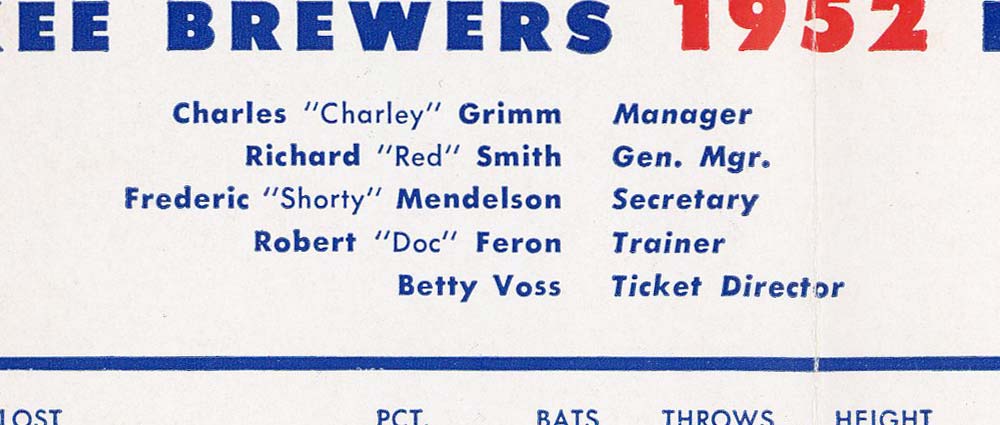
Beneath the Owgusts we have the team staff:

Manager Charlie Grimm and longtime coach turned GM Red Smith should need no introduction by now. Shorty Mendelson started working at Borchert Field when he was a kid, eventually working his way up to team secretary. He and assistant Betty Voss were frequently the only off-season employees to be found at Borchert Field once the Braves took over the Brews in 1947.

Below that is the player roster. There are some very notable names on it, first and foremost Edwin "Eddie" Mathews. The Braves' rising star had been with the Brews briefly in 1951 before being sent down to Atlanta (partly to bolster that franchise's sagging attendance). Mathews started 1952's Spring Training with the Brewers, but ended it with the Braves thanks to a lucky break. Specifically, the broken ankle of New York Giants slugger Monte Irvin. When Irvin went down on April 2, the Giants bought Bob Elliot from the Braves and promoted Mathews into the starting third baseman's role before the first pitch of the year.

Of the others, George Crowe and Buzz Clarkson were two of the first three African-American players to wear a Brewer uniform. Crowe went on to have a great career with the Braves in Boston and then in Milwaukee.

Other men on this list who played for the Milwaukee Braves include Gene Conley, Charlie Gorin, Frank Torre, Bill Bruton and Chuck Tanner. George Estock, Sid Schacht, Buddy Kerr and Luis Márquez all made it to the Braves, but were gone by the time the team relocated to "Milwaukee County's new and magnificent Municipal Stadium" in 1953.

The back of this booklet has a team photo of the 1951 Brewers, winners of both the American Association pennant and the Little World Series.
What a handsome group of men, in their uniforms so closely resembling the parent club's.

Friday, April 12, 2013

This Week in 1913: "They're Off!"

Editor's Note: This is the third in a series of posts chronicling the Brewers' first pennant-winning season.

The 1913 Milwaukee Brewers

The Brewers arrived home in Milwaukee from their Spring Training adventure on April 8th, "after having to almost swim their way out of Owensboro," according to Brownie. Manager "Pep" Clark announced that the starter for Opening Day, two days away, would be the Austrian-born Joe Hovlik. The right-handed hurler had played a pair of seasons for the Senators and one with the White Sox before being shipped to Milwaukee in 1912. In the days before artificial lighting in stadiums, he was known as a particularly effective "dark" pitcher, his ball harder to hit as the sun started to go down.

On the same day that the Brewers returned home, the Mollys packed up and shipped out to Oconomowoc for their Spring Training. They took a couple of the bigger club's players with them, as the Brews transferred first baseman Mutz Ens (who had come to Milwaukee from the Chicago White Sox as part of the deal for Ray Schalk) and pitcher Bill Powell to the junior club for seasoning.

Also on that day, the Brewers had their first public practice in Milwaukee. A "big bunch" of fans came out to the wooden ballpark to get the inside dope. The Milwaukee Journal reported that "the Brewers displayed more pepper in their first workout on the home lot... than they showed at any time last season." New skipper Harry "Pep" Clark was spreading around a little of the nickname he had earned over the nine previous seasons at Athletic Park's third base.

Expectations were high, expectations that could only be dampened by Wisconsin's infamous April weather. A mixture of snow and rain were forecast to fall on Milwaukee on Opening Day (a situation Cream City baseball fans are all-too-familiar with).

Still, the fans were ready to go, and so were the teams. A parade was scheduled ("for the first time in years") to kick off the season. Starting at the Plankington Hotel downtown, the two teams would make their way to Milwaukee Street, then to East Water, East Water to Oneida, Oneida to West Water, to State Street, to Seventh, to Grand, to Third, to Chambers, and taking Chambers all the way to the ballpark. A concert would then entertain the fans in the stands while the two teams warmed up on the field.

Splashed across the top of the April 10, 1913 Milwaukee Sentinel was a panoramic picture of Clark's men.
Here They Are, Mr. Fan! the Brewers, Who Open the Season at Athletic Park Today Against Toledo's Mudhens
Top row: Powell, Gilbert, Clemons, Berg, Charles, Noel, Watson, Juul, Lewis, Lavigne, Chapelle. Middle Row: Slapnicka, Dougherty, whitted, Ens, Nicholson. Bottom row: Cutting, Randall, Marshall, Blackburne, Clark, Jones, Block, Hughes.
In addition, the Milwaukee Journal noted that Brewer business manager Bill Armour had inaugurated a new tradition; a flag would be flown over the Majestic Building on Wisconsin Avenue - "a white flag with a blue ball in the center" - whenever the Brewers were playing a game that day. No flag on scheduled game days meant postponement. There was "some question" as to whether the flag system would be ready for the Opener, but it was expected to be in place by the second game.

And with that, the Brewers prepared to roar into the 1913 campaign. As the Sentinel put it on the morning of April 10, 1913:

Except they weren't.

The Brewers were ready, the fans were ready, but the weatherman wasn't. April 10, 1913 was a soggy, dreary day in Milwaukee. Conditions were generally poor all across the American Association, as a combination of snow and rain postponed all but a single game (Kansas City at Louisville, the visitors taking a comfortable lead in the standings with a 1.000 record). The parade was called off, the game was called off, and Milwaukeeans had to wait at least a day to see their new Brewer club. Brewer officials announced that they would try to hold the season opener the next day, April 11.

That next day wasn't any better. Rain continued to pound the Cream City, and the second game of the season was called off in the morning, before the fans got anywhere near the old wooden ballpark.

Faced with a second delay, manager Clark announced that his Opening Day starter would now be spitballer and vaudevillian Cyril Slapnicka. Hovlik would be next in line if Clark felt Cy wasn't ready to take the rubber, or if the game was delayed due to weather and Pep could count on Hovlik's "darkness" skills.

If everyone had been eager for baseball on April 10th, by the morning of the 12th they were downright desperate.

The Mudhens were particularly keen to get a game in, as they had to leave Milwaukee that evening on a train for Kansas City and their second series of the season.

Fortunately, the Athletic Park grounds were drying nicely, the rain was holding off, and at noon the Brewers announced that there would finally be a game. Armour could run his white-and-blue banner up the Majestic Building's flagpole for all Milwaukee to see.

The rain had stopped, but the air was frigid, the temperature right around freezing, as the teams took the field. 2,500 die-hards turned out, many dressed in their finest fur coats and covered in steamer blankets, and others lined the streets to peek trough knotholes.


Inside or outside the park, those brave souls were rewarded with a crackerjack game. Although the Mudhens put up a good fight, they lacked the Brewers' "pep" and were unable to plate a single run. The Brews, on the other hand, were able to score two runs in the bottom of the first. Clark came up to bat with men on the corners (outfielder Larry Chappell at first and second baseman Phil Lewis on third), and he flashed them the sign for a double steal. The Toledo catcher bit, and when he threw to second in a vain attempt to nab Chappell, Lewis was able to scramble home. Clark then lined a double off the right field wall to score Chappell and give the Brews the only runs they would need.


The Sentinel's cameras captured the action on and off the field (especially the same pair of fur-wrapped ladies that so attracted the Journal's attention).

As the Mudhens crept out of town on their way to Kansas City, the Journal puckishly observed that the Brewers' one-game win counted as a series sweep. Whoever was writing the headlines deserved a raise for this one:

"Some stunt", indeed.

The Brewers' 1913 season was off to a very stylish start.

Thursday, April 11, 2013

Party Like It's 1913!

After speaking with the Brewers, I can finally confirm that the Brew Crew will be holding a Turn Back the Clock event in May, featuring 1913 uniforms to honor the Brewers' first pennant!

The club had already announced a bobblehead of Corey Hart wearing the 1913 uniform, to be given to all fans at the May 5th game against the Cardinals. What they hadn't announced at the time, but we can confirm here, is that the Brewers and Cardinals will both be wearing throwback uniforms that day.

The Brewers haven't yet unveiled the actual uniforms, but the bobblehead gives us a good idea of what they'll look like.

I'm proud to say that I had a part in this event. I've pitched American Association Brewers throwback games before, most notably for the centenary in 2002, but the club was never all that keen on the idea. This past summer, I mentioned the idea (and the 1913 anniversary) to OnMilwaukee.com writer Doug Russell when he interviewed me for the site, and he was kind enough to put me in touch with his contacts at 1 Brewers Way. This time, the Brewers were very interested in hearing my pitch, and once they agreed I supplied them with research material on the 1913 Brews.

The Brewers based their TBTC uniform on this 1913 Milwaukee Brewers Jersey, from the collection of our very own Paul Tenpenny:

They will, of course, be making some concessions to modern uniform innovations, synthetic fabrics and numbers on the back among them. But I have hopes that they'll be able to capture the essential style of the originals.

The 1913 Brewers, of course, were the first to bring a pennant home to Borchert Field (then known as Athletic Park). Here they are, pictured right before clinching that pennant.

After taking the Association crown, the Brewers defeating the Western League's Denver Grizzlies in a post-season interleague series to claim the title of minor league champions.

The Cardinals will be in on the fun as well, wearing a re-creation of their 1913 road uniforms.

This is the third time the Brewers have honored their namesake predecessors in Turn Back the Clock events. The first, in 1993, hearkened back to a 1920s-inspired design (if not a design the Brews actually wore in the 1920s). The second, in 1996, was a throwback to 1946.

Tickets for this game are now available. I've been waiting for this for years. How could I miss it? I'm flying from Brooklyn to Milwaukee for the weekend to attend the game with two of my kids. Together we'll cheer on "our Brews" and hope for a little but of that '13 luck!

Turning Back the Clock to... 1946

The first time the Brewers held a Turn Back the Clock event honoring the Brews was July 6, 1993, when they wore uniforms more "inspired by" than actually commemorating the erstwhile club. The second time, just over three years later, would be better.

On July 31, 1996, 30,772 fans filed into Milwaukee County Stadium to watch the Brewers (then of the American League) pay tribute to their forefathers as they took on the visiting Seattle Mariners.

The clock was turned back to 1946. Hot dogs, popcorn, sodas and peanuts were sold for $1. And the teams wore throwback uniforms, with the Mariners donning the garb of the Pacific Coast League's Rainiers.

This still from the Mariners' 1996 season highlight video (courtesy of the Seattle Mariners Uniform History) shows the two teams in color.

Contemporaneous newspaper coverage gives us a better look at what the players wore. The uniforms were manufactured by Philadelphia's Mitchell & Ness, with an assist on the felt wordmarks from Ebbets Field Flannels in Seattle.

Benny Sieu/Journal Sentinel Staff Photographer
The Brewers' Pat Listach and Seattle's Alex Rodriguez sport vintage uniforms at Turn Back the Clock Night at County Stadium Wednesday.
Ah, there's a trip down memory lane: Pat Listach as a Brewer and A-Rod in Seattle.

The throwback Brewer jerseys were sold to fans at the official Brewers clubhouse shops at County Stadium and Brookfield Square. Game-worn jerseys also surface at auction from time to time. This exemplar was auctioned by Vintage Authentics in 2000:

The original 1946 uniforms were very heavily influenced by the Boston Braves, who bought the Brewers at the end of the 1946 season. It was part of a slow evolution that eventually outfitted the Brewers in virtual copies of the Braves' uniforms. At this point, the Brews were still using the distinctive script adopted by the club in 1942, but in Braves colors and with the Braves' distinctive navy/red/navy piping.

Zippers are correct for the period, although they didn't always bisect the wordmark so clumsily as the throwback jerseys indicate. The original script was often elegant even with the zipper, as seen in this gamer from 1948:

There was one jarring anachronism in the 1996 throwbacks; the cap logo. Look at Listach's helmet:

In fifty-one seasons, the Brewers never wore a cap with a "B" monogram. There were times when they wore a cap without any logo at all, but when they did it was always a Milwaukee "M".

   
I think I might know where this particular anachronism comes from. In my research, I have often seen photos from the late 1940s and early 1950s featuring Brewer players wearing "B" caps. One such photo is at right, scanned from a 1951 score card.

That's Brewer infielder Jack Weisenburger in his road grays. Weisenburger was coming off a monster season in 1950, good enough to earn him a tryout with the big club in Boston before being shipped back to Milwaukee. Anyone seeing this picture in isolation might be forgiven in thinking that his "B" cap stood for "Brewers". Actually, it was for "Boston", the proud cap of the parent Boston Braves. It appears to have been common for players to wear it in Spring Training, when many of the photographs were taken, especially those who had played for the big-league club or received a Spring Training invitation, as Weisenburger had.

If you look at the photo in its full context, however, with Weisenburger standing between pitcher Bert Thiel on the left and infielder Billy Klaus on the right, you can see that the "B" cap wasn't standard for Brewer players.

The other two men are wearing proper Brewer caps, with the proud Milwaukee "M". Looking solely at Weisenburger, it's not hard to believe that somebody might have been confused.

Interestingly, the same uniform, complete with incorrect "B" cap, is featured on the cover of Frank Nappi's coming-of-age story The Legend of Mickey Tussler, published by St. Martin's Press in 2008.

I don't know what reference cover artist Erik T. Johnson used, but perhaps he was looking at the same photos the Brewers saw when preparing for their 1996 throwbacks, or even photographs of the throwbacks themselves.

The 1946 Brewers finished the year 70-78. A rough season, especially on the heels of three straight pennants. The 1996 Brewers similarly struggled on the day they paid tribute to the '46 club, falling to the Mariners 9-3.

Monday, April 8, 2013

This Week in 1913: After the Flood, Before the Storm

Editor's Note: This is the second in a series of posts chronicling the Brewers' first pennant-winning season.
The 1913 Milwaukee Brewers

In the first week of April, 1913, Milwaukee was preparing for the the Brewers were finishing up spring training in Owensboro, Kentucky. The Journal's columnist William Wallace Rowland, who wrote under the name "Brownie", was covering the Brews in their Old Kentucky Home.

For the third year in a row, torrential rains caused flooding across the region, disrupting travel in and out of the camp. With his usual relish, Brownie reported to his readers that he had seen "a live mule on the roof of a house, while in another direction could be seen a dead horse caught on the top of a telegraph pole along the wires."

If he was less-than-enthusiastic about the Brews' decision to hold camp in the Ohio River flood district, he was encouraged by what he saw when he got there. Although the Brewers would undoubtedly feel the departures of outfielder Nemo Liebold (sent to Cleveland) and catcher Ray Schalk (sold midway through the 1912 season to the White Sox), Brownie liked what he saw from new skipper "Pep" Clark. The longtime Brewer third-baseman had been promoted to player/manager in an attempt to stop the revolving door of managers that had hampered the club. Clark, who was reportedly as beloved by his fellow players as he was by the fans in Milwaukee, had instilled "a fighting spirit" to the Brewers, "a spirit which was sadly lacking in some of last season's contests."

So, with the start of the season just four days away, Brownie wrote:
"It's impossible to try to dope out the Brewers' position, but on the whole they look like a stronger aggregation than last season's bunch."
If that wasn't enough, Cream City baseball fans would have a second team to follow from Athletic Park's wooden grandstands. In 1913, Milwaukee would field an entry in the Wisconsin-Illinois league, a minor-league circuit with teams in Madison, Racine, Green Bay, Oshkosh, Wausau, Appleton and Rockford. The new team was organized and owned by Milwaukee businessman Charles F. Moll, who had been president of the league from 1907 until early 1912.

In the days before official nicknames were de rigueur, Moll's new team was referred to by different names in the various papers; the Journal called them the "Schnitts" or even "Assistant Brewers", the Evening Wisconsin tended to report on the exploits of the "Creams", while in the pages of the Milwaukee Sentinel and other papers they were known as the "Mollys", after their owner.

While the Brewers were away in Kentucky, the Mollys were preparing to hold their own spring training closer to home, in Oconomowoc. There was no word on the flood levels in Waukesha County.

For a regular season home, the Mollys struck an agreement to use Athletic Park when the Brews were on the road, giving baseball fans a full slate of games to look forward to.

One hundred years ago today, on the front page of the Journal's Sunday, April 6th edition, in between news of riots at suffragette rallies and President Woodrow Wilson's proposed tariff cuts (and above a critique of Cubist art) was this cartoon:

Milwaukee was ready for baseball. And so were the Brewers.

Thursday, April 4, 2013

"Baseball's Greatest Maverick" iBook now $9.99!

I happened to notice today that iTunes has lowered the price on the iBooks version of "Bill Veeck: Baseball's Greatest Maverick" by Paul Dickson.

Originally priced at an absurd $27.00, it's now down to $9.99. I don't know if the original price was a mistake or if they finally saw the folly of pricing an electronic download the same as the hardcover, but any reluctance I had about buying a copy for my phone just went away.

If you haven't picked it up yet, I'd highly recommend doing so. Dickson's book is a whole lot of fun, and helps understand how the Brewers were instrumental in the development of Veeck, one of baseball's best owners.

Wednesday, April 3, 2013

Chudnow Museum - "Milwaukee Brewers Amazing Winning Streak of 1926"

The Chudnow Museum's blog has a new post up today on the 1926 Brewers' winning streak, which extended to 21 games.

They do a great job fleshing out the story (which you may remember we touched on in 2009 and then again late last year). Check it out!

Tuesday, April 2, 2013

@BorchertField

BorchertField.com has joined Twitter!

Yes, that's the 1944 team photo as our backdrop. #LoveThoseJerseys. We're using longtime team mascot Owgust as our avatar, as seen on the cover of the 1942 score cards.

We'll be posting updates, as well as general site news, "On this Day" anniversaries and other bits of interest to fans of Milwaukee's sporting history.

You can keep up with the Tweets via the widget on the right side of this page, or by Following @BorchertField on twitter.

Monday, April 1, 2013

Opening Day Crowd, 1943

In just about two hours, Brewer ace Yovani Gallardo will take the mound against the the Colorado Rockies at Miller Park. He'll throw the first pitch right around 1:10 CDT, and the 2013 season will be underway.

Seventy years ago, if not quite to the day, our Brewers were kicking off their 1943 home campaign with a game against the Minneapolis Millers. Nearly 12,000 loyal baseball fans packed into Borchert Field to watch the action, and they themselves were captured by the Milwaukee Sentinel's camera:

THEY'RE OFF AT BORCHERT FIELD—Here is a picture of the humanity packed stands at the ball park Wednesday afternoon for the Brewers' home opener with the Millers. The visitors scored an unearned run in the ninth to win, 2-1, before an unofficial attendance of 11,954 persons.
Those 11,954 fans watched a patriotic pregame ceremony featuring the American Legion, the Miller High Life band, the Junior Legion baseball champs and representatives of the Army, Navy, Marines, WAVES and WAACs. Milwaukee acting mayor John Bohn threw out the first pitch to Brewer backstop Hank Helf, and the ball was then auctioned off for $10,000.

The Orchard was ready for the season; team president Bill Veeck had installed a "spite fence", constructed of chicken wire 40 feet high, along the right field wall in hopes of containing the Millers' southpaw-heavy lineup.

The fence did its job, but as the Sentinel's photo caption notes, the Brewers lost that game in a heartbreaker. Right-handed Brewer starter "Jittery Joe" Berry pitched a brilliant game, at one point retiring nineteen batters in a row, but was let down by an offense that scored only one run and by a defensive blunder that came at the worst possible moment: the ninth inning.

The Millers' bats, having been silent since the opening pitches of the game, started to find some life in the top of the ninth. Berry retired the first batter but walked the second, Minneapolis left fielder Frank Danneker, who moved to third on a hit-and-run by Joe Vosmik. The next Miller up was pitch hitter Roy Fontaine, who tapped an easy grounder up the first base line. First-sacker Merv Connors sailed the throw home, which let Danneker score and put Millers on first and third. Jittery Joe got out of the inning by striking out catcher Frank Trechock and throwing out third-baseman "Flea" Clifton himself, but that one unearned run was the difference.

Opening Day ticket (printer's proof)

The 12,000 Brewer faithful went home "feeling like a jilted bridegroom", according to Sentinel writer Stoney McGlynn. Let's hope the 45,000 fans watching our Brew Crew this afternoon leave with a better start to the season, but even if they don't, keep in mind that the Brews still went on to claim the 1943 Association pennant, their second in a row.