Monday, October 14, 2013

Today in 1913 - Back to the Series

After a day off, the Brewers and Denver Grizzlies faced off for Game 3 of their postseason series to determine the minor league crown. The series was tied, 1-1, as the day began.

Dispatches were slow coming from Denver. It must have been especially frustrating for readers of the Milwaukee Journal, who were used to having the day's scores delivered with their afternoon paper. While waiting, the Journal was finally able to bring its readers their first pictures from Denver:

Outstanding. I love the long coat worn by pitcher Tom Dougherty, here doubling as third base coach. 

Unfortunately, that day's game didn't look so good to Milwaukee fans. The Grizzlies came out hard, hitting Ralph Cutting for three runs in four innings before Cutting was pulled for Joe Hovlik. "Pep" Clark's hand was feeling well enough for him to return to his third base duties, but he was largely a non-factor in this contest.

The most dramatic moment came in the fourth inning, with the Brewers down 3-2. Two men were on when Joe Burg came up to bat. He hit a long fly ball to center and - well, I'll let the Sentinel provide the description:
It was away over (Denver center fielder Les) Channell's head and bound for the space beyond the line of wire extended in the field for the overflow crowds on big days. Channell vaulted the wire and caught the ball, saving it from shattering the glass shield of an automobile. Runners had left the bases and had to hustle back to keep from being tagged out.
Not to be left out, Milwaukee Journal cartoonist Fred Bernau gave readers his take on the play:

Denver now had its first lead of the series, and worse yet had all the momentum. Although they were playing well, the Brewers were running the risk of being bounced out of Denver as ignominiously as Minneapolis had the year before. They would have to find a way to turn the series around.

Sunday, October 13, 2013

This day in 1913 - Take a Break, Fellas!

The Brewers and Grizzlies had an off day on October 13, 1913.

Not much to talk about, but the Milwaukee Journal was able to run this clever little cartoon showing how they might have spent their time.

The series would pick up again with Game 3 on Tuesday, October 14th.

Saturday, October 12, 2013

Today in 1913 - The Grizzlies Tie the Series

The Brewers came into their second game of the minor league championship series one up on the Denver Grizzlies. They had hit hard and well the previous day, pulling out the game when weather had threatened to shut it down early (and with a Denver lead).

The second game was very different. It was played under clear, beautiful skies, and where 3500 fans had showed up for the first game over 10,000 were in attendance at the second. They filled the stands and overflowed on to the field, filling the foul territory and lining the field with a living outfield wall.

Those ten thousand Colorado "bugs" saw a great show. It was a strong defensive affair, with only one error (the two teams had combined for 8 in the first game). As valiant as Milwaukee's glove work was, their couldn't get a handle on Denver's pitching.

Joe Hovlik got the start for the Brews. He pitched a fine game, allowing only nine hits, but the luck just wasn't going Milwaukee's way this day. Pitcher Cy Slapnicka, still filling in for Pep Clark at third, was caught leading off first base in the ninth inning. When the umpire called the final out, it was Milwaukee 2 and Denver 3. The Grizzlies had tied the series.

Even in defeat, the general consensus was that the Brewers were making a better showing than the Minneapolis Millers had in the prior season. They came to Denver dragging an American Association pennant in 1912 and got swept back to Minnesota. Not that it mattered to the Brews; they came to win the minor league crown, not get style points. They were ready for Game Three.

Friday, October 11, 2013

Today in 1913 - The Brewers Take Game One

Today in 1913, the Brewers opened their post-season minor league championship series with the Denver Grizzlies. It wasn't the "Junior World Series" that we'd come to know, but served essentially the same function, pitting the American Association champs against the Western League winners.

The first game had been scheduled for Saturday, October 10th, but snow in Denver had delayed the start one day.

If the Brewers were rusty from the train journey or the extra delay, they didn't show it. Irving "Cy" Young took the mound for the Brews, and thoroughly stymied the Denver batters. He was countered by Denver's Rufus Gilbert, who countered pitch for pitch. At the end of the fifth, with heavy clouds moving in, the Grizzlies had a 1-0 lead.

Denver would have appreciated some snow out of those clouds, because the Brewer bats came through in the sixth. Joe Burg hit a long fly ball with the bases loaded and two out, which was dropped by Grover Gilmore in left field. Lena Blackburne, Tom Jones, and Larry Gilbert came in to score. The Brews never looked back, adding another run in the eighth inning and four more in the top of the ninth for an 8-1 final score.

The Brewers weren't perfect; Pep Clark was suffering from a sore hand, hurt in the exhibition game with Pittsburg, so pitcher Cy Slapnicka took over Clark's regular duties at third. Slap had two balls hit to him, and he booted one.

A great start for Milwaukee in their quest for the minor league crown.

This week in 1913 - Mrs. Havenor Resigns

After a week of reporting bad news, it's back to chronicling the Brewers' 1913 campaign.

As the pennant-winning Brewers were heading out to Denver to face the Western League champions for the minor league crown, big things were happening back home in Milwaukee. On October 10, 1913, the club announced that team owner Agnes Havenor was stepping down from her position as president.

Mrs. Havenor had taken charge of the Brewers at the beginning of the 1912 season, upon the death of her husband Charles. At the time, she was one of the only women to run a professional baseball club. Now she was leaving her active role.

She tendered her resignation at a meeting of the Brewers' board of directors. A. F. Timme, who had been the team's vice president under her, took over Mrs. Havenor's vacated position. Milwaukee alderman Cornelius Corcoran was made vice president and Louis M. Nahin was selected as secretary and treasurer.

Havenor wasn't leaving the team altogether; she would remain the club's controlling stockholder and a member of the board of directors. The other members of that board from that point on were Timme, Corcoran, Nahin and Frank Fitzgerald.

Speaking of her retirement to the Milwaukee Journal, Mrs. Havenor had this to say:
"My one ambition was to give Milwaukee a pennant-winning ball team. Having succeeded at this, and also having demonstrated a woman's ability to attain her ambition, I am willing to step out of active management of the business. I shall always be an ardent admirer of the game. In closing I would like to thank the Milwaukee people—especially the Milwaukee women fans—for the support which they have given me in my venture during the past two years, and I fell confident that my successors will endeavor to keep up the standard, which together with the co-operation of the fans, players and my business associates, I have been able to maintain."
Her tenure in charge might have been short, but her legacy was outsized. It had been her decision to fire manager Hugh Duffy and elevate popular third baseman Harry "Pep" Clark to a player/manager role, a decision widely credited with bringing the Brewers their first pennant.

Agnes Havenor should be remembered as an exceptional team president. "A woman's ability", indeed.

Thursday, October 10, 2013

Pafko With the Brews, 1942

Following the news that Andy Pafko has passed away, BorchertField.com contributor Paul Tenpenny offers us this rare (if obstructed) view of Pafko in a Brewer uniform.

The photo was taken in Ocala, Florida on March 12, 1942. Left to right we have Stan Stencel, Bob Perthel, Pafko and Ted Gullic. Put your arm down, Ted, we can't see Andy's face!

Although the Brewers had ordered new uniforms for 1942, with "Brewers" across the chest for the first time, those are the old versions. Blue piping and caps, white "M" on the cap and red "M" on the chest. They would continue to see scattered service for at least the next two seasons.

As for the men wearing those uniforms, Gullic was a veteran in his tenth and final season at Borchert Field. Stencel had spent the first half of 1941 patrolling left field in the Orchard before finishing the season at the Brewers' top farm club in Madison. Perthel was a local kid, signed by the Brewers off an American Legion team in West Allis. And Pafko, of course, he didn't make the Brewer club that year, but he would be back. When he finally did make it to Milwaukee it wouldn't be to the Orchard but the brand-new County Stadium in a Braves uniform.

Wednesday, October 9, 2013

RIP, Andy Pafko

More sad news to report - former Milwaukee Brave (and Wisconsin native) Andy Pafko has passed away at the age of 92.

Although he was never a Brewer, Pafko came up through the Milwaukee Brewers farm system, starting out with Eau Claire before moving to Madison and then Green Bay. In 1942, Pafko came close to earning a spot patrolling Borchert Field's expansive center field, but was optioned to their farm team in Macon, Georgia by the end of Spring Training. From there he was sold to the Pacific Coast League's Los Angeles Angels.

Pafko made his major league debut with the Cubs, played parts of two seasons with the Dodgers, and then finally came to Milwaukee with the Braves in 1953.

Friday, October 4, 2013

"Forever Young"


Bill "Greek" Topitzes
by Paul Tenpenny
(Tencentz@aol.com)
Copyright 2013 Tencentzports
Printed with permission of the Author

A bright light in my life and in the life of Borchert Field history flickered out this summer. I am saddened to announce the passing of William James Topitzes. "Bill" or "Greek" to his friends, he lost his long battle with heart disease on August 28, 2013.

Truly one of my most treasured friends and fellow Brews fan, his knowledge and love of American Association Milwaukee Brewer baseball had no peer. Most of what I have written about the team from the days of Bill Veeck until their departure after the 1952 season was enlightened by Bill's memories.

While 80 years old, when he sat across from me at my home, in a restaurant or at an event ... his boyish smile always was there ...
May God bless and keep you always
May your wishes all come true
May you always do for others
And let others do for you
May you build a ladder to the stars
And climb on every rung
May you stay forever young
Forever young, forever young
May you stay forever young.

May you grow up to be righteous
May you grow up to be true
May you always know the truth
And see the lights surrounding you
May you always be courageous
Stand upright and be strong
May you stay forever young
Forever young, forever young
May you stay forever young.

May your hands always be busy
May your feet always be swift
May you have a strong foundation
When the winds of changes shift
May your heart always be joyful
And may your song always be sung
May you stay forever young
Forever young, forever young
May you stay forever young.


(Bob Dylan)
Bill Topitzes at Borchert Field
as one of the "Stars of Yesterday"


to be continued ...

Thursday, October 3, 2013

Today in 1913 - the Brewers Beat the Bucs

After two straight nights of being celebrated and toasted, the Brewers returned to the diamond for the second of their post-season exhibition games at Athletic Park.

This time they were facing the Pittsburg Pirates (the city had temporarily discarded its "h") and their star player Honus Wagner.

Cy Slapnicka took the mound for the Brews. The prose of Manning Vaughan in the Milwaukee Sentinel has to be read to be believed:
C. Slapnicka, who wishes to announce that he is a Bohemian and not a Russian, had the guys from the big tent standing on their heads, rolling over and then falling down. He pitched a grand game and with stonewall support would probably had slipped the Pirates a whitewash. Only six hits were registered off Slap and of the lot only three were honest to goodness wallops. His control was miraculous and but for a pass handed the peerless Wagner not a Pirate would have walked the plank to first. He fanned seven, whiffing every man on the club but Wagner, Miller and Kelly, the mick, who looks like something else.
Three of those seven strikeouts came in the eighth inning, when Slapnicka struck out the side. The Pirates managed to make the most out of their hits, scoring five runs. Four Brewer errors helped as well. Fortunately for the hometown fans, the Brewers managed to hit as well as Slap threw. Joe Berg at second base was the offensive hero. He had three hits and a walk in his four plate appearances, driving in a run in the fourth inning and two in the sixth. Berg's runs were the difference as the Brews took the game from their National League guests.

Wagner was reportedly won over by the Milwaukee crowd, perhaps by the ancestry he shared. "Gee, what a lot of Germans live here," he was quoted as saying. Milwaukee is some place."

Next up, the Brewers would face two local semi-pro teams before heading out to Denver to face the Grizzlies for a series to decide the minor league championship.

In the pages of the Sentinel, Cad Brand put a bow on the Brews' success against the big leaguers:

"Py Golly - I tied der Sox and licked der Pirates - now I tink I go und get a Denver sandwich"

Wednesday, October 2, 2013

Today in 1913 - "This Great Gathering of Fans"

One hundred years ago today, on the second of October, 1913, the party continued for our American Association champion Milwaukee Brewers. To the victors go the spoils, and boy oh boy was Milwaukee spoiling them.

The day after they were feted at the Majestic Theatre, manager Harry "Pep" Clark and his players were the guests of honor at a banquet organized by the Milwaukee Traffic Club and Milwaukee Press club, held right around the corner from the Majestic at the Schlitz Hotel.

The Schlitz was an ornately-furnished building in the grand tradition. Suitable for such an occasion.

The hotel was famous far and wide for its elaborate bar and massive interior beer garden, festooned with plam trees. Very suitable for such an occasion.
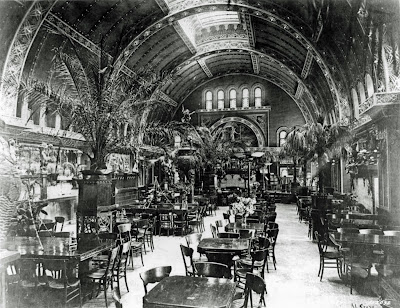
The baseball heroes were to be celebrated before local dignitaries. Governor Francis McGovern was to join Mayor Gerhard Adolph Bading on the dias, along with civic leaders such as Alderman Cornelius Corcoran (who would go on to represent the Third Ward in the Common Council for over forty years), Reverend William Thompson Dorward, pastor of the Baptist Tabernacle, (county) Judge John Colonel "Ikey" Karel and Judge Joseph G. Donnelly (chief justice of the Milwaukee civil courts and a former General Consul to Mexico).

In addition, figures from Milwaukee's baseball history were invited. Among the old-time players in attendance were Otto Schomberg, Zachariah Clayton and Tony Falch, all of whom played for Milwaukee's entry in the short-lived major league Union Association. That was, I believe, the first team to use the name "Brewers". Another old-time team, the amateur Milwaukee Maple Leaves (city champions in 1883) was represented by its former third baseman, Colonel Frank Parker.

All in all, a magnificent celebration. It certainly made quite an impression on Cad Brand's "Py Golly" character, seen in the Milwaukee Sentinel:

Not to worry, Py. They'll love you no matter what you do next year.

The phrase pinned to his jacket—"Oh You Brewers"—was commonly associated with the team in 1913.

When the evening came, six hundred baseball "bugs" filled the palm garden to join the celebration.

Looks like it must have been quite a party.

Judge Karel served as the evening's master of ceremonies, introducing each speaker in turn. First up was Governor McGovern, who said:
"In winning the American association pennant the Milwaukee club not only brings honor and glory to Milwaukee, but to the whole state of Wisconsin, and I want to congratulate Harry Clark and his great team on their triumph in bringing a championship to Milwaukee, the metropolis of this great state. Baseball is our cleanest and greatest sport, a game in which the best man wins, and I hope that the team will continue its splendid work and bring further honors to Milwaukee and Wisconsin by repeating its triumph a year hence."
Alderman Corcoran,a director of the baseball club, offered his own reflections on the title.
"I have been connected with the Milwaukee baseball team ever since it was organized, but until this year I have never had the satisfaction of being associated with a championship club. Speaking on behalf of the owner of the club, I can assure the fans of Milwaukee that the policy followed by the management of the past will be followed in the future. Money will not stand in the way of giving Milwaukee a pennant winning club, and if money can bring another championship here we will have a pennant in 1914. I wish to thank the fans for their liberal support of the club. Harry Clark has proved a wonderful success as a manager. He has the natural ability of a leader and that wonderful faculty of instilling in his men that grim determination which knows no defeat."
Next up was Rev. Dorward. A native of Scotland who retained his native brogue, Dorward was an accomplished public speaker, "one of Milwaukee's most famed preachers and teachers of elocution."
"Manager Clark, in addition to directing his team, had the plus energy of showing the way, of getting into the game itself, which is not true of most managers.

"The game of life may be compared to the game in which Manager Clark and his men succeed. But life is more than a three mile heat. It is more than a brief nine innings. Get into the game at close range. It is easy to stand back and criticize and condemn. You don't need brains to do that. Get into the game at close range with sustained effort. It is not enough to play well for a little while and then give up. How many fail and fail in life's endeavors by playing well only for a short while.

"Get into the game at short range with sustained effort until the end of the last innings."
In case anyone thought Dorward's speech relied too heavily on life lessons for the room, he also sprinkled a bit of his famous wit throughout. In referring to one of the speakers yet to take the podium, he said:
"When Judge Donnelly speaks you may get the impression that there is more Scotch in him than there is in me."
That brought the house down with peals of laughter, not the least from the judge himself.

A tough act to follow, but if anyone was up for the task it was Mayor Bading, "batting cleanup". Well known for his love of the sport, His Honor also gave a nod to the team's future while toasting its recent past.
"Too much praise can not be given Harry Clark and his men for their gallant and game fight in the American association race. Handicapped by injuries at the start of the season and during several trying periods of the race the team never gave up for a minute. They fought all the harder when they had to and were rewarded by bringing home the pennant. As chief executive of this city I congratulate Harry Clark and his team on behalf of the citizens of Milwaukee. May they repeat their victory in 1914."
Pep Clark was invited to the stage and presented with "an immense pennant, the gift of the Traffic club." Manning Vaughan reported in the Sentinel that Clark "looked as though he would rather have lost the pennant" than make another speech. Choking back emotion, Clark thanked his hosts:
"Naturally I am elated over winning a pennant in my first year as manager, but the credit is due to the boys and not me. They fought a great fight and won by outgaming their opponents. We will be out there fighting again next year and with the same club, bolstered in a few places. I hope to win another pennant. Milwaukee has certainly treated us in fine style and I wish to thank this great gathering of fans for the honor they have done us here tonight."
The evening concluded with those same fans giving three cheers for every man on the team. "Yes," wrote Manning, "it's great to be a 'champeen'."

What a "great gathering," indeed. Milwaukee Journal cartoonist Fred Bernau best summed up the evening: