Sunday, August 29, 2010

"Dinty"

This diminutive Brewer,
inch for inch, pound for pound,
proved to be a "Mighty Mite" for Milwaukee


"Dinty"
Dennis John Gearin

by Paul Tenpenny
(Tencentz@aol.com)
Copyright 2010 Tencentzports
Printed with permission of the Author

Dennis John Gearin, a man after my own heart and well ... height, was born in Providence, Rhode Island on October 15, 1897. The son of an Irish grocery store owner, he had a baseball career that spanned 15 years and had a long tenure in Milwaukee. He was arguably one of the shortest pitchers ever to play the game, at 5'4" tall and weighing in at 148 lbs (later years weighing about 160 lbs).

Gearin seemed to have collected more nicknames than any other player in the history of baseball. Most of them were due to his size and many were not very complimentary.

Denny Gearin got an early start, playing baseball for the Pawtucket Rovers (Pawtucket, RI) in the Colonial league in 1915. In the 27 games played, he pitched 203.2 innings. Unfortunately, the 17 year old pitcher lost 16 of them, while posting zero victories. A rough start for the youngster. His hitting wasn't much better, he tallied only 12 hits in his 69 times at the plate for a .174 batting average. He exhibited some power, hitting 4 doubles and a home run.

He returned to baseball with the Providence Grays of the Eastern League in 1918. In the 5 games he pitched, Gearin won 3 and lost 1 in 37.1 innings pitched. In 184 times at bat, he had 43 hits, for a .234 batting average.

His next year with Providence was more impressive. In the 14 games Gearin appeared in, he won 11 and lost 2 during the 109 innings pitched.

That year, the Oakland Oaks of the Pacific Coast League (PCL) would also give Denny a look where he went 12-7 in the 19 games he appeared in. He pitched 175 innings with an era of 3.46 for Oakland. His combined ERA for 1919 was a pretty stunning 1.88.

Dennis Gearin - 1920 Milwaukee Brewers
(Chicago Daily News)

"Little Nemo" joined the Milwaukee Brewers in 1920. Otto Borchert purchased his contract for $750 from the Oakland Oaks and brought him to Milwaukee because of his versatility. He could play the outfield and was a good hitter. Top that off of course, with his pitching ability, the left hander had a good fastball and curve ball.

Gearin became an instant hit with the team. Early on opposing teams learned the hard way how good of a hitter he was. Joe McCarthy, manager of the Louisville Colonels walked a batter to face Gearin thinking he was an easy out and was greeted with a base hit by the "midget." He should have known better as Gearin had done the same thing twice before the past week to Jack Hendricks of Indianapolis. He gave the American Association quick notice: Beware, the little Irishman is not an easy out!

Playing in 88 games as an outfielder this first year with Milwaukee, he hit for a .276 batting average while tallying a 7-9 pitching record in 21 games for the 78-88 Brews. His Earned Run Average that year was 3.80.

1920 Milwaukee Brewers-Dennis Gearin -#7

In 1921, "Nemo" Gearin, once again played in the outfield more games than he pitched. His batting average for the "Fighting Eganites" improved to .307 and his pitching record was a solid 14 wins vs. 11 losses for the 81-86 Milwaukee team. Denny Gearin, as a pitcher, had a good fastball and his "slants" kept the opposing hitters off balance.

1921 Milwaukee Brewers-Dennis Gearin-Front row
2nd from left. To his left, Manager Jack Egan.

"Kewpie" was a power house at the plate for the 1922 Milwaukee Brewers, hitting a healthy .350. He pitched in with 11 victories that season as the Brewers finished the season in 5th place at 85-83.

Dennis Gearin - 1922 Milwaukee Brewers
(Author's Collection)

1923 was a memorable year for "Dinty", pitching an impressive 12 victories vs. only 5 defeats for a 3.76 ERA. Early in the season he led the league in victories and had won six in a row. At the plate his batting average was a solid .338 by mid July.

Milwaukee Brewer President Otto Borchert said of Gearin:

"I think our team has one of the greatest players in the league in Kewpie Gearin. He is as good a pitcher as we have in the Association; he can play the outfield and hit the ball for .300 mark or better."
He was definitely being noticed outside of Milwaukee as "Jawn" McGraw, manager of the New York Giants took a chance on the "Dainty" southpaw and purchased him from the Brewers in early August.

Gearin was summoned to Milwaukee by Borchert from Indianapolis where Harry Clark's Brewers were playing.
"Gearin wanted a chance to go to the big leagues. I saw an opportunity for him to get part of the world series money this year and when he agreed to the proposition, I informed John McGraw." said Borchert.
Terms of the deal was $25,000 cash and players to be named later. They would be disclosed after McGraw had a closer look at Gearin during spring training next year, when he would evaluate all of his rookies.

"John" Gearin New York Giants
1923 Original Press Photo
(Author's Collection)

John McGraw broke from his usual preference for big pitchers by acquiring the 5'4", 150 pound Gearin in August of 1923, but felt his record showed he had the needed stamina to make it in the big show.

While with the National League Champion New York Giants, Gearin saw limited action. He got two hits in his 7 times at bat for a .286 batting average. As a pitcher he went 1-1 in the 24 innings pitched with a 3.38 ERA.

His did get a chance to appear in the World Series of 1923 as a pinch runner in the first game, won by the Giants. The New York Giants eventually lost the series to Babe Ruth's Yankees in 6 games.

He did well enough during the 1923 season to get his second look for 1924 with the Giants. McGraw needed a good left hander and thought that Gearin may fill the bill for his team.

Unfortunately for Gearin, his time in the big leagues didn't last. The Giants used him sparingly, 29 innings where he won 1 and lost 2 with a 2.48 ERA. Control seemed to be a problem as he had 16 walks, 30 hits in those innings and gave up 3 home runs.

He played briefly with the Boston Braves before returning to Milwaukee in May of 1924.

His major league totals:
2 wins and 4 losses with an combined era of 2.89.
At bat Gearin hit for a .313 average with 5 hits in 16 at bats with one RBI.
Back with Milwaukee for 1924, "Dinny" went 5-1 with a 2.89 ERA in 53 innings for the 4th place, 83-83 Milwaukee Brewers.

Dennis Gearin - Original Clipping And Autograph
(Author's Collection)

While Otto Borchert's Milwaukee Brewers tanked in 1925, finishing with a 74-94 season (only Columbus doing worse at 61-106), it proved to be a great year for the Irish lefthander. Gearin posted a 20 victory season vs. just 13 defeats.

In 1926, the much improved Milwaukee Brewers finished the year in 3rd place with a 93-71 record. While the "Mighty Mite's" play was off from his 1925 pace, it was another memorable season for the "Gill of the Shamrock," thanks to his performance on Saturday August 21, 1926.

Newspaper Headlines for 1926 No Hitter

Denny Gearin pitched himself a gem of a ball game with a no hitter against the Columbus Senators for his first place Milwaukee Brewers (80-45 at the time).

Going the distance at Milwaukee's Athletic Field, Gearin joined a pretty exclusive club when he bested the "Buckeye State" team 10-0. It was his first start since July 24th, having only pitched some innings in relief in between but he was in control the entire game.

Only 3 reached first base during his no hit victory over the "Bucks," 2 of them on free passes and one by an error. There were very few hard hit balls, only 4 of them making it to the outfield as lazy fly balls easily caught by the Brewer defense. Gearin's control was masterful with a "two foot break" on his curveball. His fastball "smoked up the alley."

He retired the first 14 batters and he set down 10 Senators by strike outs. He retired them in order in 7 of the 9 innings. His every move was cheered on by the crowd. His "dipping shoots" and "breezing fastball" kept the opposition helpless as well as hitless. It was the first Milwaukee no hit game since Joe Hovlik did it 13 years earlier in 1913.

The last no hit game for the American Association was June 18, 1921 by Bob Clark of Columbus against Indianapolis. (Clark was a teammate of Gearin with the Milwaukee Brewers in 1922)

1922 Dennis Gearin and Bob Clark
(Author's Collection)

When he curved a 3rd strike to get the final out in the 9th inning, striking out the side, the crowd gave him probably the finest ovation received by a single player in the history of Milwaukee baseball at the time.

Milwaukee had a solid offensive attack that day with Gearin being responsible for 3 of the runs. Denny proving once again, that he was more than just a good pitcher.

Dennis Gearin - Milwaukee Brewers
(Author's Collection)

In 1927 and 1928, the Brewers could do no better than 3rd place but were competitive, finishing with a 99-69 record in 1927 and 90-78 in 1928. Gearin pitched in with 8 victories in 27 and followed with 7 in 28.

The Milwaukee Brewers fell out of contention for 1929-1930, finishing far below .500 and in 7th place both years. Gearin tallied a combined total of 14 victories over those two seasons.

His last year with Milwaukee was 1931 where he had a 7-7 season.

Dennis Gearin -Signed Team Baseball
(Author's Collection)

His pitching totals while with Milwaukee from 1920-1931 were 115 wins vs. 112 losses. When playing the outfield and batting on a regular basis, Gearin was nearly always a .300 hitter.

As expected, his average dipped when pitching, but he still had an impressive overall batting average of .285 for 13 seasons in double A ball.

Denny "Kewpie-Little Nemo-et al." Gearin

Here is a "short" list of his many AKA's:
Angel
Denny
(seemed to be HIS favorite)
Dinny
Dinty
Dainty
Dainty Dinty
Gill of The Shamrock
Hermit and Leading Citizen
(Pewaukee's)
John
Kewpie
Left handed redhead
Little Forkhander
Little Nemo
Nemo
Little Irishman
Midget
Midget Southpaw
Mighty Mite
Sawed Off Red Head
Smallest pitcher in captivity
Wee Dinny
Wee Sprig of The Shamrock

Barnstorming - Babe Ruth and Lou Gehrig
(Courtesy AA Sports)

Denny Gearin's only appearance against the mighty New York Yankees was in the 1923 World Series as a pinch runner for the National League champion New York Giants.

Many wonder, myself included, how he would have fared, pitching against the likes of Babe Ruth and Lou Gehrig. Well, he sort of got a second chance at Babe Ruth when the barnstorming Bustin Babes and Larrupin Lous came to Borchert field on October 28, 1928. As part of Lou Gehrig's team, Denny faced the Bambino in front of 8,000 cheering baseball fans.

Gearin and Ruth went head to head for the first time in the 6th inning. Denny had him swinging and missing twice at his curve balls. Then the grinning Irishman got him to ground out on a slow roller to 2nd. In the 9th, Ruth still had trouble connecting with Gearin's "hooks." After a "skyscraping foul," Ruth, forever the crowd pleaser, took one over the right field fence, bouncing it on a 7th Street roof top, the ball ending up in a backyard near 6th street.

The Bams beat the Gehrigs 5-4 with that blast.

Dennis Gearin -Original Clippings, Signature
(Author's Collection)

While height may have been a factor in his limited time up in the big leagues, his competitiveness and heart were always big enough for Milwaukee. Size didn't stop Denny Gearin from being one of the Milwaukee Brewer giants for 11 years and a definite fan favorite during those roaring 20s. This Kewpie was definitely a prize that was appreciated by the Athletic Park faithful.

Denny passed away in his hometown of Providence, Rhode Island, March 13, 1959.

Milwaukee fans will always look up to you Denny.

Saturday, August 21, 2010

Hip Hip, Hooray!

The Brews always had great fans at Borchert Field, but none better than this group of young ladies captured by a Journal photographer at the 1939 home opener:

Truest supporters of the Milwaukee baseball team are these young ladies, who cheered themselves hoarse at the season's opener here Wednesday. They formed a club, the Milwaukee Brewers' Boosters, last October, made the natty outfits you see and ordered their opening day tickets last January so as to be near the Brewer dugout. Left to right are Geraldine Schneider, Janet Constantine, Mildred Wroblewski, Ethel Barber, Mercedes Oelstrom and Henrietta Constantine. (Journal Staff Photo)
The sweaters are great, but I'd kill for one of those hand-painted megaphones.

Thursday, August 12, 2010

Big News From Ebbets Field

Big news for all fans of classic baseball - Ebbets Field Flannels, the Seattle-based throwback manufacturer, is expanding their already-impressive product line. In the past, while they have been happy to make any flannel jersey as a custom order, their cap and jacket offerings have been limited to a few select clubs.

No more - now, they will special-manufacture any cap. Lots of good possibilities in the Brews' history for fans of Milwaukee baseball to order.

Ebbets Field will also make any jacket they've ever offered in the past, and even some they haven't. Which means you can have another chance to pick up the Brews' beautiful 1951 jacket.

You can place custom orders on Ebbets Field's website.

In possibly related news, EFF is also seeking investors. Oh, to have a little chunk of liquid cash. I've been a fan of theirs since I first saw a tiny ad in the back pages of the New Yorker.

Sunday, August 8, 2010

Brew City's Own Black Sox

Throughout their history, the Brews had a long relationship with their big league colleagues in the Windy City. As the closest Major League city to Milwaukee, the Chicago Clubs had the first opportunity to see the Brewers' talent, even during the periods when no formal arrangement existed between the clubs.

This was true even in the years leading up to the "Black Sox scandal." As anyone who has seen or read Eight Men Out knows, the scandal dates to the 1919 World Series, when eight White Sox players were banned from baseball for their involvement in conspiring with gamblers to throw the Series.

Of the eight regular position players on the White Sox roster during that Series, nearly half had spent time in Borchert Field's home dugout.

Oscar "Happy" Felsch, one of the players banned, was Chicago's starting center fielder. A local Milwaukee boy, Felsch was a member of the 1913 and 1914 pennant-winning Brewer squads. He was the only one of the Eight who ever wore a Brewer uniform.

Catcher Ray Schalk played for the Brews in 1911 and the first half of 1912, before being sold to the White Sox in late July for $10,000. He would return to Milwaukee for a brief managerial stint in 1940, and was elected to the Baseball Hall of Fame in 1955.

Outfielder Nemo Leibold had a more circuitous route from Milwaukee to Chicago. He was a Brewer in 1911 and 1912 before moving to the Cleveland Indians, who traded him to the Sox during the 1915 season.

The Brewers also contributed a pair of pitchers to the club:

Dickie Kerr, the "hero of the 1919 World Series", who was not in on the fix and who lashed out at his game-throwing teammates, pitched for the Brewers in 1917 and 1918 before going to the Sox.

Frank Shellenback had a brief stay in Milwaukee in 1917 before heading to the Minneapolis Millers and then Chicago.

In addition to the men who stopped in Milwaukee on their way to the South Side, there were two pitchers on that infamous club who make the journey in reverse, becoming Brewers after the 1919 season.

Dave Danforth was a left-hander who spent all of 1926 and part of 1927 in Milwaukee.

Charlie Robertson, who went on to throw a perfect game for the Sox in 1922, was a Brewer in 1926, 1929 and 1930.

The stain of the 1919 World Series lingers today, its Milwaukee connection almost forgotten. But in charting the history of Milwaukee baseball, we have to take the good with the bad.

Saturday, July 31, 2010

Good Godfrey! "A Most Fearsome Man" at the Orchard

By Pete Ehrmann


Editor's Note: Today our resident boxing expert brings us the story of a very unusual match which took place at the Orchard exactly seventy-nine years ago, on July 31st, 1931.

George Godfrey

George Godfrey possessed every attribute necessary to become heavyweight champion of the world except the proper skin tone. So even though he beat plenty of other contenders, he never got the chance to fight for the big enchilada himself because after Jack Johnson the people running boxing weren't about to go through that again.

Johnson, the first African-American to win the title, reigned from 1908-'15, and was hated for that, for the ease with which he bowled over the White Hopes sent up against him, plus his very public fondness for fast cars and white women.

John L. Sullivan, the first modern-era heavyweight champ, was a drunken blowhard, but that didn't bother many back when the heavyweight champion of the world was as exalted a figure as the President of the United States. It was considered a sign of Sullivan's true moral character that he refused to risk his title against black Australian Peter Jackson, and when his successors also drew the "color line" against black contenders they were cheered for it as fervently as Tommy Burns was condemned for fighting Johnson and losing to him.

After Jess Willard unhorsed Johnson in 1915, the heavyweight championship of the world was again made off-limits to black fighters for another 22 years.

Shut out of title consideration, they had their own "colored championship," and in the late 1920s it belonged to George Godfrey.

"He was a legendary fighter, a most fearsome man," wrote Larry Gains, another famed black fighter of that time. "With the possible exception of (Jack) Dempsey, he was the best and most destructive heavyweight in the world. He was so powerful that he didn't just beat men, he ruined them. It came to the point where no white man would fight him, unless the handcuffs were on."

The handcuffs were on in 1930 when the 6'4", 230-pound Godfrey was matched with Primo Carnera, the Italian giant being steered to the world title by his mobster handlers in a series of blatantly fixed fights. In the February, 1948 issue of Sport magazine, Jack Sher wrote that Godfrey "had a terrible time losing to Primo. It was almost impossible for this boy to fight badly enough for the huge Italian even to hit him! He finally solved the dilemma by fouling Primo in the fifth round.

"After the fight, several suspicious reporters came into Godfrey's dressing room and began to ask how hard Primo could hit. 'Hit?' the large Negro grinned, 'That fellow couldn't hurt my baby sister.' The reporters began to laugh and then into the room walked several of the gentlefolk" — mobsters — "who were handling Carnera. Godfrey's face changed. 'That white boy sure has some punch,' Big George said quickly. 'I thought the house had fallen in on me a couple times there.'"


Whether Godfrey was the "colored heavyweight champion" when he stepped into the ring at Borchert Field on July 31, 1931 isn't certain. It didn't make any difference, though, because he wasn't wearing boxing gloves. Tired of the runaround he got in boxing, Big George was now a wrestler.

Wrestling was popular in Milwaukee, and the reigning local idol and Godfey's opponent at Borchert Field was Ernst "Ernie" Scharpegge, about 6'4" and 230 pounds, whose losing match against heavyweight champion Gus Sonnenberg a year earlier had sold out the Auditorium.

Ernie Scharpegge

About 1,500 fans were at Borchert Field for what the Wisconsin News called "one of the worst, and yet one of the most exciting, grin and grunt affairs in Milwaukee."

On the eve of the match it sounded like Big George wasn't quite reconciled to his new profession.

"There is nothing that would suit me better than to have one of those big beef artists use the wrestling holds and let me punch him full of holes," he told the Wisconsin News.

But when the match started he managed to refrain from reverting to old habits. After 10 minutes of grappling, Scharpegge won the first fall with a crotch hold and body slam.

When the best two-out-of-three falls match resumed, it was Scharpegge who resorted to fisticuffs after Godfrey got him in a strangle hold, punching George in the stomach and chin. Godfrey retaliated with a right that sent Scharpegge to the mat.

At that point, more than 12 uniformed policemen rushed into the ring and surrounded Godfrey. As the bell rang and the crowd started to boo, "It looked like the start of riot," reported Ronald McIntyre of the Milwaukee Sentinel.

But then Scharpegge and Godfrey shook hands and the match resumed. Within moments, Scharpegge took another swing at Godfrey, and when the referee objected he took a swing at him. The cops rushed back into the ring, and Scharpegge took a few of them on, too.

The result was a win by disqualification for Godfrey ("whose forbearance," wrote "English 'Arry" in the Wisconsin News, "proved that a white heart beats beneath an ebony exterior"), and a column in the Milwaukee Sentinel the next day by Ronald McIntyre blasting promoter Tom Andrews for making the "sad mistake" of pitting a white man against a black man in the ring.

"He might have known that the chances were about 10 to 1 it would end up the way it did -- in a near riot," wrote McIntyre, who oddly blamed Godfrey even though Scharpegge tossed the first punch.

"If Andrews had stopped to consider the possibilities of a Godfrey-Scharpegge match, he might have realized its shortcomings. In the first place, Godfrey cannot wrestle, and in the second place, he cannot get away with the rough tactics Scharpegge might get away with in a match with a Sonnenberg or a McCoy.

"Because he knew little or nothing about wrestling holds, Godfrey had a stranglehold on Scharpegge's Adam's apple most of the time after the first fall. This goaded Ernst into action and he got rough… When the punching started, Godfrey might just as well have quit for he realized that if he started slugging, a race riot might have ensued."


From the Milwaukee Sentinel, August 1, 1931

Since apparently he was going to get belted in the ring no matter what, Godfrey returned to boxing. In 1935, he even won recognition as heavyweight champion by an obscure European outfit called the International Boxing Union.

"Godfrey has had a remarkable career," wrote columnist John Lardner. "Like most negroes who devote their spare time to fisticuffs, he has been a magnificent but erratic fighter. If I had George in his prime, and were sure that he meant business, I would back him to beat the Joe Louis of today. He was bigger, faster and wiser than Louis, and he carried a knockout punch in both hands.

"But George was an employee at heart. When the evening's program called for him to lose by foul, knockout, or decision, he did so. He was satisfied to do so, provided he received his ration of pork chops after the entertainment. George made a bum out of our national pork supply. He also made a bum out of himself."


That was a pretty harsh judgment about a fighter whose race and not his appetite rendered him "an employee at heart." Harsher still was the end for Big George. At age 50, he "died in poverty in his dingy little room" in Los Angeles on August 13, 1947, reported the Associated Press, "with only his large black dog by his side."

Sunday, July 25, 2010

People Who Made Borchert Field a Special Place, Part III

by Dennis Pajot


Editor's Note: This is the third in a series of articles about the behind-the-scenes people at Borchert Field, the people essential to the team's operations but whose contributions have gone largely unsung. Earlier installments are here and here.

Andrew L. Lehrbaummer wrote a story of his remembrances of Borchert Field for the 1981 Milwaukee Sentinel. Andrew lived up the street at 8th and Locust, and as people parked in front of his house he would ask if he could watch the person's car while that he was in the ball park. After the game little Andrew would get a nickel or a dime. The Borchert Field workers usually allowed the neighborhood kids to came into the park around the 7th or 8th inning, and one Sunday when Andrew went in to watch the last innings, guess who he sat next to? The man recognized him and asked "Aren't you the boy who is supposed to be watching my car?"

Lehrbaummer remembered picking up cushions after games and receiving a handful of peanuts for the service. When a little older he helped in the Refreshment Division, bagging Virginia Goobers in the morning and occasionally hawking them during the game. As a senior in high school, Andrew only had morning classes and could make some money at the ball park in the afternoons. Selling Cherry Blossom, Orange Crush, Green River, cream and white soda (and remember these wooden cases contained glass bottles!) for a dime each, the young man would make 30 cents on each case. However, he supplemented his income by selling the empty cases for 50 or 75 cents to the outfield standees.

Lehrbaummer remembered the other types of vendors at Borchert. The scorecard and cushion sellers made the gbest sales prior to the game. Of course, the beer vendors were popular, beer selling for 20 cents a bottle. But the peanut vendors were the envy of the other sellers. Two of these vendors, Lefty Hummer and Jake Backes, carried 115 bags in the large wicker arm baskets. Some items that disappeared to future generations were Angelus marshmallows and One Eleven or Fatima cigarettes. Borchert Field had refreshment stands where 10-cent hot dogs were sold. Andrew told one hot dog story about Otto Borchert. The Brewer owner would come down from the press box, start to talk, and reach around the counter to take a hot dog from the aluminum container just below the counter. Otto would than dunk the hot dog in the community mustard bowl before enjoying it. (From the Milwaukee Sentinel, April 16, 1981)

Lehrbaummer was another of the unsung heroes of Borchert Field. Hopefully, just like the park itself, we will not forget the people who helped make it an unforgettable place.

Sunday, July 18, 2010

A Potted History of the Orchard

This delightful one-panel illustration was printed in the Brewers' 1947 programs:

Aside from playing through some of the more memorable events at Borchert Field over the previous few decades, the graphic also told fans about the changes that were being made by Lou Perini and his Boston Braves, new owners of the club (but not, interestingly, the ballpark; the Orchard had remained in the hands of Otto Borchert's widow Idabel Borchert since his death the day before the 1927 home opener).

Most interesting, perhaps, is that the home plate was moved twenty feet to the north, farther away from the backstop. This shortened the distance from straightaway center field from 392' to 375', not to mention the power alleys.

There's so much to love here. I bet I can get a dozen articles out of the entries from the entries on this sketch. Stay tuned.

Thursday, July 8, 2010

Cap-ital Opportunity

I don't usually hawk commercial products, but Ebbets Field Flannels has a great sale on their reproduction 1936 Milwaukee Brewers cap.

This handsome cap was worn by the Brews when they captured the 1936 pennant, bringing the American Association flag back to the Cream City. Regularly $35, it's on sale now for only $19.

I don't have any financial interest whatsoever in the sale of these caps, but I do have an interest in seeing more AA Brewers merchandise in stores, and the best way to get that done is demonstrate to Ebbets Field that the market exists. Buy one or twelve today, and show your support for the Brews!

The sale lasts through Monday, July 12 - place your orders now! I did.

Wednesday, June 30, 2010

"Casey at the Bat"

Sport shirts packed away, "Leatherneck" Bill was occupied in the Pacific. Charlie Grimm was hearing the siren call from the "Walls of Ivy." Veeck would be fuming, Stengel was assuming ... the management of the Brews...


"Casey at the Bat"
The 1944 Milwaukee Brewers

by Paul Tenpenny
(Tencentz@aol.com)
Copyright 2010 Tencentzports
Printed with permission of the Author


DUTY CALLS...

With the dawning of 1944, the United States of America entered its 3rd year of World War II. By this time, no one seemed to be spared getting their call up from Uncle Sam, including fathers with children. This author's father was no exception.
Milwaukee's International Harvester Plant 1944
(Author's Collection)


Tenpenny J.R.

Milwaukee Brewers owner, Bill Veeck had enlisted in the Marine Corps in November 1943.

"The draft never bothered me," explained Veeck to the Milwaukee Journal's R.G. Lynch. "I knew they were going to get around to me, but I was going to wait until they did. Then they began to draft fathers. That made things different. Sure, I've got 3 children, but I can go and know Ellen (Mrs. Veeck) and the kids will be alright. I mean I am in a better position to go than a lot of other men who have kids. I couldn't sit back and let the draft get those fellows first, so I volunteered. It was the only way I could feel right about it."

The Milwaukee Brewers President was in excellent health at the age of 30, and reported for duty to Marine Corps Base Camp Pendleton, San Diego, California in early December. After 7 strenuous weeks, Veeck finished boot camp on Jan 29th. Soon afterwards, Private First Class William Veeck Jr. was deployed with other Marines to the Pacific, reportedly serving in Bougainville and Guadalcanal.

With Veeck gone, the club was in the very capable hands of Manager Charlie Grimm and General Manager Rudie Schaffer, who was made acting President. Don Stewart of the Chicago Cubs was to join the Brewers in an advisory capacity in January. A longtime friend of Bill Veeck, he came with a lot of baseball experience under his belt. Unfortunately, he left 3 weeks later to take the top job with the Cubs affiliate in Los Angeles. Charlie Grimm was named team vice president soon afterwards.

After winning the American Association pennant in 1943, the Brewers were flush with money and were able to look for players to replace departing ones during the winter months. Milwaukee needed a catcher to replace the departing Hank Helf. 1st base was a concern because Heinz "Dutch" Becker was expected to play with the Cubs in 1944. They were also in need of a 2nd baseman to replace Don Johnson. Dick Culler was seen as an excellent shortstop for the upcoming year to replace Tony York. Bill Nagel was slated to take over the hot corner from departed Grey Clarke.

Their outfield was pretty well set, with Hal Peck expected to return to his hard hitting, fleet footed self in right field. Hershel Martin was expected to continue his superb hitting and fly catching in centerfield. Bill Norman and Frank Secory were both vying for the 3rd spot in the pasture.

Grimm felt his pitching was better than what they had in 1943. Expectations were high for pitchers Charlie Sproull, Owen Scheetz and Charlie Gassoway, who had been a bit unpredictable from the left hand side the previous year. He was expected to mature into a quality pitcher.

SPRING TRAINING IN "MUDVILLE" ...

Charlie Grimm as "Casey at the Bat" 1944 Photo
(Author's Collection)

Charlie Grimm waxed poetic on March 9, 1944 when he portrayed Thayer's beloved character, "Casey at the Bat" for the Milwaukee Athletic Club crowd. It would later prove to be prophetic early on during the season.

With spring training slated to open March 20, the Milwaukee Brewers would be returning to Waukesha's Frame Field. Exhibition games were planned against local industrial teams. While the team jested about the weather and discussed dog sleds and snowball fights last year, 1944 would be no joking matter. The reality of playing baseball in Wisconsin's winter would be painfully apparent this year.

Back to "Mudville" - near Waukesha's Frame Field
The Moor Mud Baths
(Author's Collection)

Charlie Grimm didn't have to go to the Moor Mud baths to be neck deep in the muck, as field conditions at Frame field were muddy enough for him. The weather would not cooperate with the Milwaukee Brewers in Waukesha. Attempting any training at Frame Field was darn near impossible. The Brewers were forced to hold indoor sessions at a riding Academy in nearby Hartland until the grounds dried out.

While practicing indoors was fine for the pitchers and catchers. Grimm needed a playing field for game like conditions for his infielders. The Brewers were ever hopeful that conditions would improve. They made adjustments, which included turning the field around and having the batting cage in deep center field so the hitters, at least, could get in some practice. The infield though, was "still a morass."

Charlie was very much concerned about conditioning his team.

"Unless we get some outdoor practice pretty soon, I am afraid to think what might happen to us when we open our exhibition season schedule against the University of Wisconsin Madison April 1st." said Grimm. "So far we have not had much of a chance to hold fielding practice. The diamond at Frame Field may not be ready for a few more days but at least we were able to work out on the grassy sidelines."

Conditions at Frame Field were so bad that The Brewers were even exploring practicing at Borchert Field!

Players braved the cold weather in Waukesha, running and playing pepper but the home plate resembled a "hog wallow" making it impossible to practice. Then came the snow. Charlie Grimm had had it. He was "Fed Up" with trying to train in Wisconsin. "Enough is enough," he said and suggested the Cubs training center at French Lick, Indiana. "We just can't get in the right kind of shape with these conditions and there is no competition for the team to put on edge."

The club, according to their manager, just wasn't ready to play with the season opener looming 2 weeks away, on April 19th.

In spite of their spring training woes, American Association sportswriters picked the Brewers to finish 1st place for 1944. They garnered 8 first place votes, with Columbus (4) and Indianapolis (3) also receiving 1st place votes. A vote of confidence came from the Milwaukee Sentinel's Red Thisted for "Jolly Cholly" Grimm to get the most out of his players as he did last year.

The Columbus Red Birds skipper, Nick Cullop, didn't agree. He felt the Brewers were weaker this year and felt his team was positioned to be a strong contender.

Ready or not, with only 16 innings of exhibition ball behind them, the Milwaukee Brewers were set to open their 1944 campaign. They would have to "play our way into shape."

In spite of the spring training disaster, the Milwaukee Brewers were considered a strong team for 1944. The outfield was anchored solidly in centerfield with Hershel Martin, considered one of the best outfielders in the league. Dick Culler at shortstop with Tommy Nelson at second gave strength to the infield in the middle and would rival last year's combo of Tony York and Don Johnson.

The Brewers sported some of the best pitching in the league with Gassaway and Acosta coming from the portside and had ample throwers from the right side as well. Sproull, Scheetz, Farmer, Caldwell, Bob Bowman and Dick Hearn. The catching was in good hands with Jim Pruett and rookie Ken Raddant backing him up.

Add to this strong nucleus the likes of Hal Peck, Frank Secory, Heinz Becker (back from Chicago), Bill Nagel, Bill Norman and Ed Scheiwe, the Brewers were ready to have at the league on opening day.

1944 Milwaukee Brewer Program
(Author's Collection)

1944 Brewer Roster-American Association Almanac
(Courtesy Rex Hamann)
Note* Scheiwe is correct spelling.

With the war effort in Milwaukee considered important again this year, the Brewers continued with plans to do their part with furnishing much needed recreation for the workers in defense plants. Baseball games at Borchert Field were vital to moral and the well being of the workers and families. Production at the facilities improved due to these games according to local plant managers. Morning games for factory workers would again be included for 1944. Defense plant discounts will also be renewed for this year with special ticket prices offered for the local defense and factory workers. A.O. Smith, Froemming Bros. Inc., the Miller Brewing Company, Siemann Body plant of Nash-Kelvinator Corporation, Harnischfeger Corporation and the Cleaver Brooks Company were some of the participants. Ladies nights would, of course, be scheduled as usual too.

Entertainment was on the agenda for home games at Borchert like last year.
Hersh Martin and his "Brewer Wildcats" were scheduled to play June 12th. Martin at the piano was now in charge of the troupe while Bill Veeck was away with the marines. Joining him this year would be Ed Scheiwe on mouth organ, catcher Jim Pruett at the drums, and Dick Culler playing a mean base fiddle. Bob Bowman scraped out rhythm on his washboard. "Hot jive folks can jitterbug to." Also singing at the "Orchard" will be the "Cuban Frank Sinatra" Julio Acosta.

THE SEASON BEGINS ...

In spite of the poor conditions during spring training and the resulting worries about the players being ready, Charlie Grimm's Brewers were strong out of the gate grabbing immediate hold of first place. Opening day brought in 13,569 eager fans.

But there were rumblings in nearby Chicago where Jimmie Wilson quit as the Cubs manager on May 1st. Rumors surfaced immediately that Milwaukee's manager Charlie Grimm was being considered for the job. He told the Milwaukee Sentinel's Red Thisted that he was not contacted and would remain in Milwaukee to look out for his and Bill Veeck's interests, but added an "unless..."

Charlie stated he would have to get a "marvelous" offer to consider going back to Chicago. That had the fans up in arms. Charlie Grimm was a much loved icon in Milwaukee and was credited along with Bill Veeck with rebuilding the national pastime in Milwaukee. Charlie was their manager, their comedian, their friend and like Bill Veeck, someone fans felt would help make Milwaukee a major league city.

But the court of public opinion didn't have much of a chance to voice its case, as it was announced officially that Casey Stengel would take over as manager of the team and that Charlie Grimm was Chicago bound with Casey taking over the reigns in Milwaukee Sunday May 7th.

Charlie in Chicago - 1944 original press photo
(Author's Collection)

One would assume that Brewer owner and president Bill Veeck was part of the negotiations and approved of these changes, but that wasn't the case. He was at war and thus, out of circulation. It happened so fast it caught Leatherneck Bill completely by surprise. To say he was "Agog" or in a "Dither" about the changes, would be putting it mildly.
"I'm coming out of a mess hall on Bougainville this night and I hear a sports flash on the camp radio. It says Charlie Grimm, manager of my Milwaukee Brewers, has been signed to replace Jimmie Wilson of the Chicago Cubs. Then the announcer says Casey Stengel is taking over as manager of the Brewers. That's all I hear, but it is enough ... I'm stunned. Six weeks later I get the straight dope by mail, but by that time I'm snapping in for some new kind of neurosis. After I hear the news I don't know what to think. I'm on guard duty the same night and all night long all kinds of thoughts are rushing through my head. What are they DOING to me? Is my pal Grimm mad? Why doesn't somebody tell me these things?"
(Veeck in interview with Marine Corps Combat
Correspondent S/Sgt Gordon D. Marsten 1944)


THE MIGHTY CASEY...

Casey at the Dugout-signed photo
(Author's Collection)

Stengel had managed at the major league level with the Brooklyn Dodgers from 1934-1936 and also with the Boston Braves (Bees) from 1938-1943. He had been a skilled right fielder, playing in the major leagues from 1912 to 1925. Charles Dillon Stengel had a lifetime batting average of .284 over 14 seasons. He also had a reputation of being a bit of a clown, but was all business when it came to playing and managing.

"To follow a man like Grimm in Milwaukee is probably the toughest job I ever tackled." he stated in the club offices, "But I am going to pitch with everything I have and I think we will all get along splendidly."

They did get along splendidly. His Milwaukee Brewers didn't miss a beat with Casey in charge and continued their winning ways.

On May 12 they buried the Indianapolis Indians 16-3 for their 9th straight victory in a 19 hit game. Hal Peck hit 2 home runs, a double, a single, and drove in 5 runs. Tommy Nelson contributed a 3 run homer in the eighth inning and had two great defensive plays, snagging a hard line drive in the 2nd and snaring another ball, made a spectacular glove hand flip to Culler to get the force out in the 4th inning.

Hal Peck Original Photo
(Author's Collection)

Hershel Martin was the hero in their 11th consecutive victory against Louisville.
Milwaukee's star outfielder tallied 4 hits and drove in 7 runs in a 13-3 drubbing of the Colonels to complete the series sweep. Martin was looking forward to returning to Milwaukee for some "home cooking."

Hershel Martin Sportrait
(Author's Collection)

The Brewers would lose Martin in June to the New York Yankees in a trade for Ed Levy, announced Vice President Mickey Heath. He assured the team that this deal wouldn't hurt the team. The Brewers also added pitcher Don Hendrickson and catcher Roy Easterwood. Ken Raddant did a decent job at catcher, backing up Jim Pruett but was not quite ready for AA ball.

The Brewers continued their dominance of the league in July, having won 12 of 20 road games leading up to the 4th of July. Slumps didn't last long for Stengel's Brewers and winning double headers were becoming common place for the team. Taking two from Kansas city 25-7 and 5-1, and two from Saint Paul, 5-1 and 7-6. More would follow throughout the season.

George Binks was the hot topic of major league owners and his former boss, Charlie Grimm was fielding questions about Bingo and his .415 batting average.

"Ever since joining the Cubs in early May I have been getting long distance phone calls from major league owners and scouts about George Binks."

Pinch hitting for his pitcher, "Bing Bang" Binks belted a 3 run home run to secure the victory against the Millers for pitcher Charlie Sproull.

Charlie Sproull - Original Autographed Photo
(Author's Collection)
Milwaukee's pitching was well balanced with Earl Caldwell having one of his best years in baseball. Offensively Milwaukee was hitting a collective .316 and had plenty of power at the plate with Becker, Binks, Levy, Nagel, Peck, and Secory. Bill Nagel, who came to the Brewers as partial payment for Grey Clarke via the White Sox, was just off the chart with 102 RBI's.(And it was only July!)

As the month came to a close, Milwaukee was 11 games ahead of Louisville with a record of 74-30.

August found the Brewers dealing Ed Scheiwe and some cash to Kansas City for infielder Arky Biggs. Needing some utility help, Biggs was expected to more than adequately fill the bill. Biggs was hitting .364 with the Blues prior to his joining the Brews. The race tightened up a bit in August with Toledo trailing the Brewers by 7 1/2 games. Talk of the playoffs circulated among the players, even if a bit prematurely.

September 1st had the Milwaukee Brewers solidly in first place with a 92-46 record. The Brewers clinched the American Association Championship September 6th with a 6-0 shutout victory by Julio Acosta over the Saint Paul Saints. This was the second time in two years that the Cuban Showboat clinched the game for Milwaukee. He clinched it in 1943 by beating Indianapolis.

Julio Acosta - Original Autographed Photo
(Author's Collection)
"Was I OK tonight?" Acosta asked as he dressed ... "You pitched your best game of the season tonight," said outfielder Bill Norman to the Cuban side wheeler.

The Brewers occupied and held 1st place all season long and General Manager Rudie Schaffer lamented: "This would have been a perfect day, if only Bill (Veeck) was here to see the club he built before joining the marines win the pennant."

1944 Team Photo
(Author's Collection)

(This 1944 set of Milwaukee Brewer baseball card series was again done by Milwaukee's Grand Photo Studio. These (3 1/2 x 5 1/2 inches) cards are similar to the previous year's offering but did not have the Grand Studio name on the cards. They had printed autographs and were sold at the Borchert Field concession stands and by mail, for 25 cents a set.

Considered scarce, they demand a premium price when found in complete near mint sets. Here is a rare view of the complete 26 card set.)


Julio Acosta / Heinz Becker
1944 Grand Studio Cards
(Author's Collection)

A surprise birthday present for Jolly Cholly in 1943, Julio Acosta jumped out of a cake at Borchert Field. In 1944, Julio won 13 while losing 10 with a 3.89 ERA. He was considered one of the best lefties in the American Association for the year.

First baseman Heinz Becker, after a short spring with the Chicago Cubs, rejoined the Brewers. He improved his batting average to .346 in 146 games in 1944.

George Binks / Bob Bowman
1944 Grand Studio Cards
(Author's Collection)

George Binks was a clutch utility player in the field and at home plate for Milwaukee. He batted .374 over 100 games playing both the outfield and filling in at 1st base in 1944.

Bob Bowman went 1-0 in limited play in 1944.

Earl Caldwell / Dick Culler
1944 Grand Studio Cards
(Author's Collection)

Earl 'Teach" Caldwell had one of his best years in baseball as he led the American Association with a 19 win vs. 5 loss season in 1944. His ERA was a cool 2.97.

Shortstop Dick Culler was superb at shortstop and was part of the best double play combination in 1944, Culler to Nelson to Becker. He hit a solid .308 for the season. Quick on the base paths, he used the great Ty Cobb's fall away slide, throwing his body away from the base and reaching to tag the base with his hand. An all around clutch player for the Brews.

Roy Easterwood / Jack Farmer
1944 Grand Studio Cards
(Author's Collection)

Catcher Roy Easterwood, a needed backup catcher late in the season, played in 37 games in 1944 with a BA of .283.

Jack Farmer pitched in with an 8 and 6 record and a 2.96 ERA.

Charlie Gassaway / Dick Hearn
1944 Grand Studio Cards
(Author's Collection)

Lefty Charlie Gassaway pitched in with a smokin' 18 wins vs. only 8 losses. His ERA was a classy 2.75 and he did well as both starter and a reliever.

Dickie Hearn tallied a 6-7 record in 103 innings pitched.

Don Hendrickson / Ed Levy
1944 Grand Studio Cards
(Author's Collection)

Don Hendrickson went 12 and 7 with an excellent 2.57 ERA in 1944.

Ed Levy replaced Hershel Martin in the outfield with a .286 BA in 46 games.

Hershel Martin / Bill Nagel
1944 Grand Studio Cards
(Author's Collection)

In 58 games, Hershel Martin hit .358. before joining the New York Yankees at mid season.

Slugger Bill Nagel playing 3rd base hit .308, the Brewer RBI leader. Bill wanted to play outfield but, Charlie Grimm in need of infielders suggested he try 3rd base. "I will do the best I can Charlie but I would rather play outfield." Well, his play at 3rd proved to be a great asset to the Brewers with his strong throwing arm. He rarely made a bad throw. He also provided "booming base hits." Manager Casey Stengel was a big backer of his as Nagel played very well on opposing ball fields. Opposing players respected his prowess "at the dish with ducks on the pond."

Tommy Nelson / Bill Norman
1944 Grand Studio Cards
(Author's Collection)

At 2nd base in 1944, Tommy Nelson played 146 games for the year hitting for a .303 average. An awesome infielder, he was a key part of the Milwaukee Brewer defense.

Bill Norman was much improved over last year hitting .296.

Hal Peck / Jimmy Pruett
1944 Grand Studio Cards
(Author's Collection)

Outfielder Hal Peck hit a smokin' .345 for the year. An expert bunter, some insisted he was even faster since shooting his foot in an accident at his home in 1942, which was expected to slow him down. "When I was in the hospital for more than a month in 1942. I thought my baseball days were definitely finished." said Peck. "...I got a pep talk from Bill Veeck. It sort of cheered me up and I made up my mind I was going to be a big leaguer, toes or not. " Casey Stengel called him his " million dollar baby."

Jimmy Pruett hit .312 along with his catching duties. He was considered "fearless" in his blocking of the plate. His many female fans were no doubt upset with is marriage during the 1944 season.

Ken Raddant / Owen Scheets
1944 Grand Studio Cards
(Author's Collection)

Young Ken Raddant filled in as catcher for 27 games early in the season and batted .241.

Pitcher Owen Scheetz went 11-7 for the year.

Eddie Scheiwe / Frank Secory
1944 Grand Studio Cards
(Author's Collection)

Erwin "Eddie" Scheiwe played briefly at shortstop compiling a BA of .243.

Frank Secory's play was solid in the outfield in 88 games and contributed with a BA of .290 and a fielding average of .946.

Red Smith / Floyd Speer
1944 Grand Studio Cards
(Author's Collection)

Red Smith continued on as a valuable coach for the Milwaukee Brewers, which was especially important with the absence of Bill Veeck.

Floyd Speer pitched 108 innings for a 7 - 2 record.

Charlie Sproull / Casey Stengel
1944 Grand Studio Cards
(Author's Collection)

Charlie Sproull wowed the crowd with his 2.50 ERA and posted a record of 16 - 7.

The not so "Old Perfesser" Casey Stengel took over the helm from the departing Charlie Grimm. He provided a smooth transition and led the team to victory in 1944. He proved his mettle as a manager in Milwaukee and would go on to be elected to the Baseball Hall of Fame as one of baseball's greatest field generals with the New York Yankees.

1944 American Association Champions

Thanks to Bill Veeck's and Charlie Grimm's building of the franchise, the Milwaukee Brewers had a strong base to work with in the winter of 1943-1944 that was considered at a pre-war standard. In Veeck's absence, Grimm, Rudie Schaffer and others put together the needed pieces for a great team. With Grimm's early departure and his hiring of Casey Stengel, the team was left in competent hands. Brewer announcer Michael "Mickey" Heath stepped out of the background to become Vice President after Grimm moved on to Chicago. A Milwaukee Brewer baseball player himself and good judge of talent, he made important decisions during the season to shore up the team and help keep them on track and winning. Heath and Veeck had discussed players on a regular basis in the past and Veeck always respected Mickey's opinion with player personnel, so his choice was a natural.

The 1944 Milwaukee Brewers had the power of several big bats to drive them towards the pennant. Becker, Biggs, Binks, Culler, Levy, Nagel, Peck, and Secory all contributed. Pitching was a strength the team relied on in the stretch. Acosta, Caldwell, Gassaway, Farmer, Hendrickson, Scheetz and Sproull. Both Gassaway and Hendrickson spent time starting and relieving.

Any slumps did not last long and no one really came close to the Brewers who clinched the season in early September for their 2nd consecutive American Association crown.

Casey Stengel - Original Autographed Photo
(Author's Collection)

Casey Stengel's Brewers finished with Milwaukee's best record in the history of the franchise at 102 - 51. Although they were picked to win it all, including the Little World Series, the 3rd place Louisville team had something to say about that. Louisville had bested the Brewers in 10 of the 22 games played between them. They had tough pitching that had given the Brewers trouble during the regular season. The Brewers after leading the series 2 games to 1, fell victim to "cheap infield hits" by the Colonels and breakdowns in pitching did them in, according to Casey.

Unfortunately, like Charlie Grimm before him, his 1944 Brewer team went down in the first round of the playoffs, 4 games to 2.

...Oh, somewhere in this favored land the sun is shining bright;

The band is playing somewhere, and somewhere hearts are light,

And somewhere men are laughing, and somewhere children shout;

But there is no joy in Mudville - mighty Casey has struck out.

Casey at the Bat by Ernest Lawrence Thayer ©

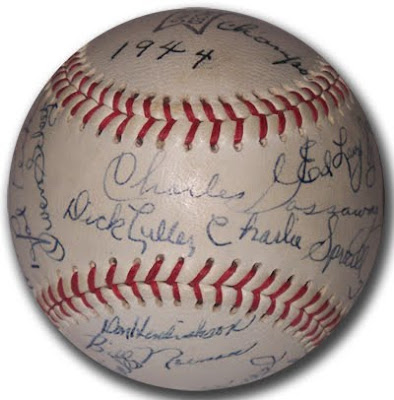
1944 Signed Team Baseball
(Author's Collection)


Pfc. William Veeck Jr. returned to Borchert Field in December 1944, a year after leaving Milwaukee to join the Marine Corps. Behind him was the war in the Pacific; ahead of him would be the struggle to regain his health and rejoining his beloved Milwaukee Brewers for the 1945 season.

December 1944 -Back at Borchert