Friday, October 4, 2013

"Forever Young"


Bill "Greek" Topitzes
by Paul Tenpenny
(Tencentz@aol.com)
Copyright 2013 Tencentzports
Printed with permission of the Author

A bright light in my life and in the life of Borchert Field history flickered out this summer. I am saddened to announce the passing of William James Topitzes. "Bill" or "Greek" to his friends, he lost his long battle with heart disease on August 28, 2013.

Truly one of my most treasured friends and fellow Brews fan, his knowledge and love of American Association Milwaukee Brewer baseball had no peer. Most of what I have written about the team from the days of Bill Veeck until their departure after the 1952 season was enlightened by Bill's memories.

While 80 years old, when he sat across from me at my home, in a restaurant or at an event ... his boyish smile always was there ...
May God bless and keep you always
May your wishes all come true
May you always do for others
And let others do for you
May you build a ladder to the stars
And climb on every rung
May you stay forever young
Forever young, forever young
May you stay forever young.

May you grow up to be righteous
May you grow up to be true
May you always know the truth
And see the lights surrounding you
May you always be courageous
Stand upright and be strong
May you stay forever young
Forever young, forever young
May you stay forever young.

May your hands always be busy
May your feet always be swift
May you have a strong foundation
When the winds of changes shift
May your heart always be joyful
And may your song always be sung
May you stay forever young
Forever young, forever young
May you stay forever young.


(Bob Dylan)
Bill Topitzes at Borchert Field
as one of the "Stars of Yesterday"


to be continued ...

Thursday, October 3, 2013

Today in 1913 - the Brewers Beat the Bucs

After two straight nights of being celebrated and toasted, the Brewers returned to the diamond for the second of their post-season exhibition games at Athletic Park.

This time they were facing the Pittsburg Pirates (the city had temporarily discarded its "h") and their star player Honus Wagner.

Cy Slapnicka took the mound for the Brews. The prose of Manning Vaughan in the Milwaukee Sentinel has to be read to be believed:
C. Slapnicka, who wishes to announce that he is a Bohemian and not a Russian, had the guys from the big tent standing on their heads, rolling over and then falling down. He pitched a grand game and with stonewall support would probably had slipped the Pirates a whitewash. Only six hits were registered off Slap and of the lot only three were honest to goodness wallops. His control was miraculous and but for a pass handed the peerless Wagner not a Pirate would have walked the plank to first. He fanned seven, whiffing every man on the club but Wagner, Miller and Kelly, the mick, who looks like something else.
Three of those seven strikeouts came in the eighth inning, when Slapnicka struck out the side. The Pirates managed to make the most out of their hits, scoring five runs. Four Brewer errors helped as well. Fortunately for the hometown fans, the Brewers managed to hit as well as Slap threw. Joe Berg at second base was the offensive hero. He had three hits and a walk in his four plate appearances, driving in a run in the fourth inning and two in the sixth. Berg's runs were the difference as the Brews took the game from their National League guests.

Wagner was reportedly won over by the Milwaukee crowd, perhaps by the ancestry he shared. "Gee, what a lot of Germans live here," he was quoted as saying. Milwaukee is some place."

Next up, the Brewers would face two local semi-pro teams before heading out to Denver to face the Grizzlies for a series to decide the minor league championship.

In the pages of the Sentinel, Cad Brand put a bow on the Brews' success against the big leaguers:

"Py Golly - I tied der Sox and licked der Pirates - now I tink I go und get a Denver sandwich"

Wednesday, October 2, 2013

Today in 1913 - "This Great Gathering of Fans"

One hundred years ago today, on the second of October, 1913, the party continued for our American Association champion Milwaukee Brewers. To the victors go the spoils, and boy oh boy was Milwaukee spoiling them.

The day after they were feted at the Majestic Theatre, manager Harry "Pep" Clark and his players were the guests of honor at a banquet organized by the Milwaukee Traffic Club and Milwaukee Press club, held right around the corner from the Majestic at the Schlitz Hotel.

The Schlitz was an ornately-furnished building in the grand tradition. Suitable for such an occasion.

The hotel was famous far and wide for its elaborate bar and massive interior beer garden, festooned with plam trees. Very suitable for such an occasion.
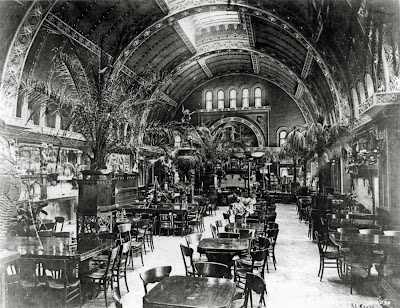
The baseball heroes were to be celebrated before local dignitaries. Governor Francis McGovern was to join Mayor Gerhard Adolph Bading on the dias, along with civic leaders such as Alderman Cornelius Corcoran (who would go on to represent the Third Ward in the Common Council for over forty years), Reverend William Thompson Dorward, pastor of the Baptist Tabernacle, (county) Judge John Colonel "Ikey" Karel and Judge Joseph G. Donnelly (chief justice of the Milwaukee civil courts and a former General Consul to Mexico).

In addition, figures from Milwaukee's baseball history were invited. Among the old-time players in attendance were Otto Schomberg, Zachariah Clayton and Tony Falch, all of whom played for Milwaukee's entry in the short-lived major league Union Association. That was, I believe, the first team to use the name "Brewers". Another old-time team, the amateur Milwaukee Maple Leaves (city champions in 1883) was represented by its former third baseman, Colonel Frank Parker.

All in all, a magnificent celebration. It certainly made quite an impression on Cad Brand's "Py Golly" character, seen in the Milwaukee Sentinel:

Not to worry, Py. They'll love you no matter what you do next year.

The phrase pinned to his jacket—"Oh You Brewers"—was commonly associated with the team in 1913.

When the evening came, six hundred baseball "bugs" filled the palm garden to join the celebration.

Looks like it must have been quite a party.

Judge Karel served as the evening's master of ceremonies, introducing each speaker in turn. First up was Governor McGovern, who said:
"In winning the American association pennant the Milwaukee club not only brings honor and glory to Milwaukee, but to the whole state of Wisconsin, and I want to congratulate Harry Clark and his great team on their triumph in bringing a championship to Milwaukee, the metropolis of this great state. Baseball is our cleanest and greatest sport, a game in which the best man wins, and I hope that the team will continue its splendid work and bring further honors to Milwaukee and Wisconsin by repeating its triumph a year hence."
Alderman Corcoran,a director of the baseball club, offered his own reflections on the title.
"I have been connected with the Milwaukee baseball team ever since it was organized, but until this year I have never had the satisfaction of being associated with a championship club. Speaking on behalf of the owner of the club, I can assure the fans of Milwaukee that the policy followed by the management of the past will be followed in the future. Money will not stand in the way of giving Milwaukee a pennant winning club, and if money can bring another championship here we will have a pennant in 1914. I wish to thank the fans for their liberal support of the club. Harry Clark has proved a wonderful success as a manager. He has the natural ability of a leader and that wonderful faculty of instilling in his men that grim determination which knows no defeat."
Next up was Rev. Dorward. A native of Scotland who retained his native brogue, Dorward was an accomplished public speaker, "one of Milwaukee's most famed preachers and teachers of elocution."
"Manager Clark, in addition to directing his team, had the plus energy of showing the way, of getting into the game itself, which is not true of most managers.

"The game of life may be compared to the game in which Manager Clark and his men succeed. But life is more than a three mile heat. It is more than a brief nine innings. Get into the game at close range. It is easy to stand back and criticize and condemn. You don't need brains to do that. Get into the game at close range with sustained effort. It is not enough to play well for a little while and then give up. How many fail and fail in life's endeavors by playing well only for a short while.

"Get into the game at short range with sustained effort until the end of the last innings."
In case anyone thought Dorward's speech relied too heavily on life lessons for the room, he also sprinkled a bit of his famous wit throughout. In referring to one of the speakers yet to take the podium, he said:
"When Judge Donnelly speaks you may get the impression that there is more Scotch in him than there is in me."
That brought the house down with peals of laughter, not the least from the judge himself.

A tough act to follow, but if anyone was up for the task it was Mayor Bading, "batting cleanup". Well known for his love of the sport, His Honor also gave a nod to the team's future while toasting its recent past.
"Too much praise can not be given Harry Clark and his men for their gallant and game fight in the American association race. Handicapped by injuries at the start of the season and during several trying periods of the race the team never gave up for a minute. They fought all the harder when they had to and were rewarded by bringing home the pennant. As chief executive of this city I congratulate Harry Clark and his team on behalf of the citizens of Milwaukee. May they repeat their victory in 1914."
Pep Clark was invited to the stage and presented with "an immense pennant, the gift of the Traffic club." Manning Vaughan reported in the Sentinel that Clark "looked as though he would rather have lost the pennant" than make another speech. Choking back emotion, Clark thanked his hosts:
"Naturally I am elated over winning a pennant in my first year as manager, but the credit is due to the boys and not me. They fought a great fight and won by outgaming their opponents. We will be out there fighting again next year and with the same club, bolstered in a few places. I hope to win another pennant. Milwaukee has certainly treated us in fine style and I wish to thank this great gathering of fans for the honor they have done us here tonight."
The evening concluded with those same fans giving three cheers for every man on the team. "Yes," wrote Manning, "it's great to be a 'champeen'."

What a "great gathering," indeed. Milwaukee Journal cartoonist Fred Bernau best summed up the evening:

Tuesday, October 1, 2013

Today in 1913 - A "Big Harvest of Sheckels"

One hundred years ago today, the Brewers were back in Milwaukee. The American Association season was over, the pennant won. And now, it was time to get to work.

The Brewers were scheduled on a train to Denver to face the Western League champion Grizzlies in a forerunner of the Little World Series. There was still baseball to play in the Cream City, however.

Four exhibition games had been scheduled at Athletic Park, two against major league teams (the White Sox and Pirates) and two against local semi-pro clubs. Team owner Agnes Havenor donated use of the ballpark, uniforms, equipment, and uniforms, while Harry "Pep" Clark and his men would keep the box office (minus a cut for the visitors).

As the Journal put it, the Clarksmen were ready to "reap (a) big harvest of sheckels". The Brewers were already victors; now it was time to start receiving their spoils.

Those sheckels had to be divided appropriately. The players voted to give full postseason shares to every man on the 1913 roster save two: Happy Felsch and Dan Marion. Both joined to the Brews late in the season, the hard-hitting Felsch from the Milwaukee (and later Fond du Lac) Mollys of the Wisconsin-Illinois League. Those two were expected to receive a smaller cash settlement for their efforts. In addition, a full share was accorded club secretary Louis Nahin.

The players also set their roster for the Denver series, with all the regulars save three. Pitcher Phil Lewis was out with an injured ankle, while pitcher Buster Braun and infielder Orville Woodruff chose to take themselves off the roster to save traveling expenses (all three would retain their share of the winnings).

First up was an exhibition with Chicago. White Sox manager Jimmy Callahan was determined not to lose to a minor league club, so he brought his full squad north to Milwaukee, including former Brewers Larry Chappell and Ray Schalk. They came on strong, and a pair of throwing errors spotted the Sox to a 2-0 lead by the bottom of the second. The Association champs settled down and countered with a run in the fourth and two in the sixth. They took that run into the top of the ninth, when a dodgy umpiring call let the Sox sneak a tying run in. The two teams went scoreless in the tenth but darkness was setting in over Athletic Park, and the game was called. Callahan's squad hadn't lost to their minor league foes, but neither were they able to defeat them. The Brewers had held their own against an American League club in a game both teams wanted to win. The boys split the money as well as the glory; each team took half of the gate receipts, $2,851 in total. That meant a payday of $80 for each of the Brewers, the equivalent of nearly $1,900 today.

After the game, there was another event. The Brewers were whisked to the Majestic Theatre on Wisconsin Avenue. This time, the Brews got to sit in the audience and watch others perform.

Tom Jones, the "big Welshman", was awarded a trophy from Bunde & Upmeyer, a "silver bat and ball properly engraved", for winning the Brews' batting title. Clark was presented a large bouquet of flowers in the shape of a pennant. Clark gave a brief speech in which he essentially asked to be excused from giving a speech. "We are ball players, not after-dinner speakers." They were also heroes to the sold-out crowd, which whooped and hollered as though they were at Athletic Park.

More dinners and testimonials were on the calendar, but the Brews must have felt as though they already had a pretty full day.

Monday, September 30, 2013

Today in 1913 - "Champion Brewers Return to Pennantville"

One hundred years ago today, your Milwaukee Brewers returned home from Kentucky with the American Association pennant in hand and several thousand baseball fans waiting to greet them at Union Station.

The Brewers' train was two hours late, and by the time it reached the city the route was lined by cheering fans trying to get a look at player/manager Harry "Pep" Clark and his boys.

The players noticed the gathering crowds along the track. Pitching ace Cy Slapnicka thought better of it, and snuck out a window while the train was stopped at Second Street. He missed a fantastic reception at the final destination, as crowds surrounded the train and cheered every man as he alighted from the train.

The players were relieved of their luggage and led to waiting cars. Clark tried to give a speech to the assemblage, but the crowd noise drowned out his words. The procession of automobiles carried the Brews down Grand Avenue towards downtown, the streets lined with an estimated thirty thousand cheering "bugs", "as though the president were paying a visit to Milwaukee". Word of the party spread far and wide. The New York Times reported on the festivities:
MILWAUKEE, Wis., Sept 30.—Milwaukee still is baseball mad, despite the fact that the American Association season closed yesterday. Several thousand "fans" crowded about the Union Station here to-day, and with brass bands and other noise-producing instruments welcomed home the Milwaukee team, winners of the association pennant, and incidentally the first pennant ever won by a Milwaukee team.

The players were escorted to automobiles which led a parade about the downtown districts. A big banquet in honor of the team will be held Thursday night, and seats for the function are selling at a premium. Theatre parties and receptions have been planned, and record-breaking crowds are expected to attend exhibition games to-morrow and Thursday with the Chicago Americans and Pittsburgh Nationals.
The Milwaukee Journal worked up a marvelous front-page cartoon in honor of the city's victorious heroes.

Look at the detail:

"Agnes of Arc" is team owner Agnes Havenor, who took over the team upon the passing of her husband Charles in April 1912. She's shown here in a full suit of armor on horseback, surrounded by Brewers and leaving a pile of defeated American Association opponents behind her. One of thevanquished exclaims "A woman may have RIGHTS but by George Agnes goes TOO FAR!" An interesting sentiment considering its time; just the previous year Wisconsin voters had rejected a referendum that would have given women full suffrage (the 19th Amendment was still six years in the future, although Wisconsin would later brag about being the first state to ratify it).

Havenor was herself a crucial figure in the team's success on the diamond, having elevated popular veteran third baseman Clark to his player/manager role at the end of the 1912 season. Clark took the fifth-place club and turned it around to a champion in his first season at the helm.

Never one to miss an opportunity, the Journal also presented its "baseball mad" readers with nearly two full pages of appropriately-themed ads:

I love the pitch for "Brownie"'s coverage of the Brews in the lower-left corner.

In the lower-right, that drawing of right-hander Tom Dougherty was originally published on July 23rd, when he blanked the Toledo Mud Hens 12-0.

Speaking of recycled graphics, the Sentinel pulled a doozy. They reprinted Cal Brand's "Py Golly" cartoon from the previous day with a slight change of caption: "The Brewer Team Will Return Home on Tuesday for Well Earned Rest" became "The Brewer Team Returned Home on Tuesday for Well Earned Rest":
The impromptu parade was the only event on the Brewers' schedule that day, but the following would start a series of formal celebrations for the team. Milwaukee was indeed "baseball mad" for her pennant-winning Brewers.

Sunday, September 29, 2013

This weekend in 1913 - "It's All Over but the Shouting, and That is Still Going On"

Yesterday we saw how five thousand fans crowded in front of the Sentinel building in downtown Milwaukee to hear Brewer play-by-play related to them via wore (and megaphone). The Brewers were in Louisville with an opportunity to clinch their first American Association pennant.

So how'd the Brews do? Remember, they needed to win at least one game from the Colonels and have the Minneapolis Millers lose one. The Millers obliged, dropping the first game of their double-header in Columbus, 13-3, while the Brewers' first game was still in progress. Now it was up to third baseman/manager Harry "Pep" Clark and his boys.

The Brewers opened the game showing some of the strain they had been under for months. The Milwaukee Journal told its readers that "lines of anxiety marked every (player's) face and for a time it looked as though the team would break under the strain." The usually sure-handed shortstop Lena Blackbourne booted an easy grounder in the top of the first, allowing a Colonel to advance into scoring position. Fortunately Milwaukee had ace Cy Slapnicka on the mound, and he was able to pitch himself out of the jam with a well-timed strikeout.

After that shaky start, the Brewers started to take over. Even the ball started bouncing their way; when a Louisville drive lined right off Slap's leg in the third, not only was the hurler unscathed but Pep Clark was able to snag the ricochet in time to nail the runner at first.  The Brewers and Colonels remained scoreless through the first five frames. 

The "Clarksmen" were aggressive on the basepaths - they had three runners caught stealing in the first five innings - and the strategy finally paid off in the sixth for the game's first run. With two outs and nobody on, Blackbourne managed to draw a walk and then went to work. He stole second base on the next pitch and moved to third when the Louisville catcher's throw to second bounded into center field. Blackbourne stood 90 feet from a Brewer lead when first baseman Tom Jones strode to the plate. The "big Welshman" took a mighty swing at a pitch from Lousiville's Grover Loudermilk, but he got over the ball. His line drive went almost straight down, striking the turf just in front of the plate and bouncing high in the air. Jones was off running, and by the time Loudermilk could get a handle on the ball his throw to first was late. Blackbourne scored in the confusion, and the Brewers were on the board. 

They followed it up with two more runs in the top of the ninth.  Even though the Colonels managed to plate a run in the bottom frame, it wasn't enough. The Brewers had won their first pennant. 

Milwaukee players sprinted out of the dugout and embraced on the field, yelling and waving to the small but noisy handful of Brewer fans who had made the four hundred-mile trip down from the Cream City.  As they celebrated, Brewer backstop "Doc" Marshall yelled up to the press box "Tell 'em up in Milwaukee to get that pole!"

The Kentucky fans were gracious in defeat, glad at least that their rivals in Minneapolis were denied the crown. The home fans gave the visitors a round of applause "in true southern style".

There was another game to play, but the Brewers didn't seem all that interested in the second half of the day's double-header, and when the game was called on account of darkness after five½ innings the Colonels had taken it 3-0. Here are the box scores for the two games: No matter about that second game; the Brews had what they came for.

The following morning, the Sentinel splashed its congratulations across the top of the front page:

It's a little busy, with the players' faces threatening to obscure the word "CHAMPIONS", but I think the paper could be excused its enthusiasm. The "Py Golly" character in the middle is an interesting one. He seems to have been cartoonist Cad Brand's own mascot for the club, a Scandanavian-accented booster who chronicled the team's story in the pages of the Sentinel.

Much of the credit for the pennant was laid at the feet of Pep Clark. Although 1913 was his first campaign in the double player/manager role, he had been Milwaukee's third baseman since 1904 and was well-liked throughout the league. When he came up to bat for the first time in that darkness-shortened second game with Louisville, the home fans gave him a round of applause. Pep responded by tipping his cap, the gentleman.

His graciousness was also on display the following day, in a Sentinel piece appearing under his name. Playing off his nickname, the article was entitled "Pep and Energy Won, Says Clark:
Pep and determination won the pennant. The boys certainly deserve all the credit in the world. They're the gamest bunch of fellows I ever played with. They never knew when they were beaten.

When Minneapolis passed us two weeks ago not a man on the team lost hope. They battled all the harder, battled their way back into the lead and on Sunday nailed the flag to the pole.

It was a tough fight and I am glad it is over. Now that we have the pennant I might as well confess that I have slept hardly a wink in the last week. After that 20 to 10 reverse in Indianapolis on Friday you could have cut the gloom with a cheeseknife. I was down in the mouth and so was the whole bunch.

But we went back full of confidence on Saturday and we won. We all felt better after that, but were all on edge when we started that first game Sunday afternoon. It wore off as the game progressed and after we scored that run in the sixth inning I don't believe I ever felt happier or more confident in my life. It also put new life in the boys, they were in there to battle for every inch and they certainly came through in fine style.

I had a good ball club all season. We had a lot of bad luck or I believe we would have had the flag clinched a week ago. My pitching was strong, the club was a hard hitting one, while in the field it played great ball.

This combination and an iron bound fighting determination to fight all the way made for a championship club.

Now for a pennant in 1914.
Brave words from the Brewer skipper, but also an acknowledgment that the pressures of the season had been weighing on the club.

That evening, reporters found pitcher Joe Hovlik in the hotel lobby. Between puffs of his Havana, Hovlik echoed Clark's relief. Well, he told them, I'll get a decent night's sleep now, and believe me it will be the first one I have had in two weeks."

The next day, the Brewers would finish the season with another twin-bill before heading back to Milwaukee and their fans. Banquets had already been planned, and a grateful city was eager to welcome back her heroes.

A post-season series was scheduled between the Brewers and the Denver Grizzlies, champions of the Western League, for bragging rights over all the minor leagues. But that was all to come. For now, it was time for celebration and sleep, although perhaps not in equal amounts. Milwaukee was a championship town.

Saturday, September 28, 2013

Today in 1913 - "Come and Hear... the Brewers Clinch the Flag"

One hundred years ago today, on Sunday, September 28, 1913, the Brewers stood on the brink of clinching their first American Association pennant.

The Brews had finished a series in Indianapolis, and were en route to Louisville, where they would face the third-place Colonels in a double-header. The Minneapolis Millers, then in second place, were playing their own double-header in Columbus. In fact. every game on the American Association schedule that day was a twin-bill, bringing fluidity and a resulting drama to the standings.

The Brewers had several roads to the pennant in the few remaining games; the Milwaukee Sentinel outlined the various combinations this way:
   If Milwaukee wins the first game and Minneapolis also wins the opener, Milwaukee must win another to cop unless Minneapolis loses the next three.
   If Minneapolis wins a double header on Sunday and Milwaukee loses a double header Milwaukee must win one on Monday unless Minneapolis loses a double header on Monday.
   On the other hand:
   If Milwaukee loses a double header on Sunday and loses a double header on Monday and Minneapolis loses two out of four Milwaukee wins the pennant.
   Or if Milwaukee loses the first three games and Minneapolis wins the first three, and then Milwaukee wins one and Minneapolis loses the fourth, Milwaukee wins the pennant.
   Or, to make it easier, if Milwaukee wins the first game of Sunday's double header and Minneapolis loses the first one the pennant is won for Milwaukee.
Confused yet? Not to worry, the Sentinel followed that up with this analysis:
   You are at liberty to try any combination you like. We can't lose.
Outstanding. You have to love that confidence.

The Sentinel editors weren't the only ones feeling pretty good at the Brewers' chances. The Milwaukee Traffic Club and Milwaukee Press Club scheduled a banquet for the Brewers, to be held at the Schlitz Hotel on October 2 ("whether they win or lose the pennant"). The Brewers were also scheduled to attend a party in their honor at the Majestic Theater on October 1st.

The players themselves were reported to "figure that the pennant is as good as won." Manager "Pep" Clark, on the other hand, "refuses to admit that he has the pennant though of course he admits that he has a pretty slick chance." Clark told the Milwaukee Journal "We'll battle 'em to the last.":
"It's going to be a hard fight, but the Brewers can be relied upon to fight until the last man is out. It's been a hard season but our boys have stood up wonderful under the strain, and they have been aided greatly by the well wishes of the Milwaukee fans. We are in the last round now and are ready and waiting, and may the best team win."
If Clark was hesitant to claim victory, he might have been the only one. Congratulatory letters and telegrams were pouring into the Brewer offices by this point, to the extent where Clark mused that he might need a secretary to answer them all. And from Minneapolis, the second-place Millers seem to have acknowledged their uphill climb to the flag, as seen in this Sentinel report that Minneapolis manager "Pongo Joe" Cantillon (himself a former Brewer skipper) had called to congratulate Pep:

Cream City baseball fans were eating it up. Unfortunately, the potential clinchers were being played 400 miles to the south, too far for most Brewer fans to travel. How could the "bugs" follow the action? Radio was still in its infancy; WHA, the oldest station in the country, wouldn't start its experimental broadcasts until 1914, and actual game broadcasts were still more than a decade in the future. Fortunately, Milwaukee's great morning newspaper had a creative solution:

   Because of the tremendous interest in the Colonel-Brewer double header in Louisville TODAY, The Sentinel has arranged to give the fans every detail of both games the instant they happen.

   A special wire will run from Eclipse park, Louisville, into The Sentinel office, and as soon as the plays flash over the wire they will be announced by a megaphone man in front of The Sentinel building. The first game will start at 1:30 o'clock.

   Every detail of the Minneapolis-Columbus games will also be announced.

   Come and hear whether the Brewers clinch the flag TODAY or not.
"Come and hear"? Who could resist an invitation like that? Certainly not the five thousand Brewer fans who turned up to hear the "megaphone man" relay each play:

Among that crowd were many women who, the Sentinel reported, "prove(d) almost as enthusiastic as the men". The police tried valiantly to keep the street clear for traffic, a task which became progressively harder as the game went on and which was eventually abandoned.

So who won the games? Unlike those 5,000 fans outside the Sentinel building, we'll have to wait just a little longer to discuss that. See you tomorrow....

Thursday, September 26, 2013

Today in 1913 - Milwaukee's "Men of the Hour"

On this day one hundred years ago, the Brewers were closing in on the American Association pennant. This photo of the team was featured in the pages of the Milwaukee Sentinel:

Top row—Carroll, pitcher; Felch, utility outfielder; Turner, catcher; Marshall, catcher.
Second row—Lewis, second base; Jones, first base; Randall, right field; Beall, left field; Dougherty, pitcher.
Third row—Powell, pitcher; Blackburne, shortstop; Gilbert, center field; Slapnicka, pitcher; Young, pitcher; Clark, third base and manager; Hovlik, pitcher.
Bottom row—Braun, pitcher; Hughes, catcher; Berg, utility infielder; Woodruff, utility outfielder; Cutting, pitcher.
As the caption notes, with six games left to play in the 1913 season, our Brews had a 3½ game lead over the second-place Minneapolis Millers.

Their Brewers' pursuit of their first pennant was almost complete. The finish line was in sight.

Sunday, September 22, 2013

1948 Pocket Schedule

Time for another pocket schedule, this time from 1948.

On the cover, your '47 Milwaukee Brewers, with manager Nick Cullop front and center. Those Brewers won the Little World Series in 1947 (but not the American Association pennant, in a quirk of the league's rules), and big things were expected of them this year.

As far as I know, 1948 was the first season the Brews used that italicized version of the script wordmark introduced in 1942. It would appear on subsequent schedules and team publications, but never the uniforms themselves.

The inside holds the schedule of games. Although this copy has significant paper loss, all the text is still there. Note the absence of any announced exhibitions with major league clubs, formerly a regular event at Borchert Field (plus a new foil label for Miller High Life!).

On the back, play-by-play man and former Brewer first baseman, coach and manager Mickey Heath. Heath had provided radio broadcasts of Brewer games since 1940, and was still going strong.

Look at those prices - Box seats were only $1.50 or $.90 for kids under 12 (the equivalent of $14.56 and $8.73 in 2013 dollars, respectively). Grandstand seats were $1.00/$.40 ($9.70/$3.88), and a bleacher ticket would only set you back $0.60/$0.40 ($5.82/$3.88). What a deal.

Milwaukee fans saw some pretty good ball for that money, as the Brewers went 89-65 on the season. That was good enough for second place, eleven games behind the white-hot Indianapolis Indians, who won 100 games.

Thursday, September 19, 2013

1926 Milwaukee Badgers team photo

Here they are, the Milwaukee Badgers in their final season, posing before Borchert Field's grandstand in 1926.

Photograph courtesy of Dr. Kit Neacy, DDS

Milwaukee had its very own National Football League team from 1922 through 1926. The city was promised another NFL franchise for the 1931 season, but the selected new owner couldn't fund the club and the opportunity passed. There might have been another, but in 1933 the Green Bay Packers played their first Milwaukee game at Borchert Field, and from then on the entire state was Packer territory.

Don't forget the Chudnow Museum of Yesteryear is hosting a lecture on the Badgers tonight at 6pm.

Michael D. Benter, author of the new book The Badgers: Milwaukee's NFL Entry of 1922-1926, will be speaking on the history of the team. Benter is also the author of The Green and Gold Glory Years Quiz Book (on the Lombardi-Era Packers) and Roll Out The Barrels: The Brewers of Eastern Dodge County.

Tickets are $3 for the General Public, $2 with Student ID. Attendees are asked to register in advance.

The museum is located at 839 North 11th Street in Milwaukee, a little over 2 miles due south of where Borchert Field once stood.

Wednesday, September 11, 2013

1933 Pocket Schedule

This pocket schedule invited fans to follow their Brewers in the 1933 season. It is a single piece of goldenrod cardstock with two-color print in a dramatic black and red.


In 1933, Brewer highlights could be found on WTMJ. The Milwaukee Journal's station would lose them to WISN (no later than 1937), and they in turn would be replaced by WEMP as the home for Brewers play-by-play by 1948. WEMP would retain the rights through 1952, the Brewers' final season.

On the back, an ad for motor oil:


Wadham's Oil Company was a an oil and gasoline company based in the Cream City in the early 20th Century.

In 1916, gas stations as we now know them were in their infancy. The first drive-up gas station in the United States had opened just three years earlier in Pittsburgh. Wadham's recognized an opportunity and decided to enter that new market, realizing that it could sell its product directly to the public through a series of roadside filling stations.

Their first station opened the following year, and by 1930 Wadham's had over one hundred custom-built stations throughout metro Milwaukee. As this 1934 ad tells us, every fourth car in Milwaukee filled up at a Wadham's pump:


The Wadham's service stations themselves were an early exercise in buildings-as-branding. Designed by Milwaukee architect Alexander C. Eschweiler, the stations were decorated in the Japonist style, topped with red stamped-metal and tile pagoda roofs. The buildings themselves served as advertisements for the stations, selling a sense of Eastern romance and adventure to passing motorists.


Wadham's was purchased Vacuum Oil Company in 1930, which was then acquired by Socony, which later became known as Mobil. Many of the distinctive Wadham's buildings are still found around the city, repurposed and preserved to various degrees.

Wadham's stations were decorated in a trademark red, black and gold color scheme, which might account for the printing on this card.

Sunday, September 8, 2013

1924 Milwaukee Badgers Photo, and Lecture at the Chudnow Museum of Yesteryear

Today, the Green Bay Packers will kick off their 2013 season in San Francisco against the 49ers. As we look forward to another year of football, it's the perfect time to reflect on Milwaukee's own NFL history.

This photo shows the 1924 Milwaukee Badgers:

Photograph courtesy of Dr. Kit Neacy, DDS

Over a decade before the Packers played their first Milwaukee game at Borchert Field (in fact, five years before Athletic Park was renamed for Otto Borchert), the Badgers were representing the Cream City in the National Football League.

Notable Badgers included former Packers star Johnny "Blood" McNally and his fellow future NFL Hall of Famers Fritz Pollard and Jimmy Conzelman, as well as a young actor, singer and law school student named Paul Robeson, who would go on to become an icon of the Civil Rights movement.

The Badgers played from 1922 through 1926. A second incarnation of the Badgers was created in 1930 with the promise of another spot in the NFL, but the team folded before finishing a single season. Three years after that, Curly Lambeau started playing home games in Milwaukee, and from that moment on Milwaukee was strictly Packer territory.

The Chudnow Museum of Yesteryear is hosting a lecture on the Badgers on September 19th, 2013 at 6pm.

Michael D. Benter, author of the new book The Badgers: Milwaukee's NFL Entry of 1922-1926, will be speaking on the history of the team. Benter is also the author of The Green and Gold Glory Years Quiz Book (on the Lombardi-Era Packers) and Roll Out The Barrels: The Brewers of Eastern Dodge County.

Tickets are $3 for the General Public, $2 with Student ID. Attendees are asked to register in advance.

The museum is located at 839 North 11th Street in Milwaukee, a little over 2 miles due south of where Borchert Field once stood.

Wednesday, September 4, 2013

Reflections of the Orchard, from 1936 to 1979

On Tuesday, August 28, 1979, the Milwaukee Brewers were taking on the Royals in Kansas City when when they ran right into what the Milwaukee Sentinel called a "double play with comic overtones" that "would have stolen the show in a Marx Brothers comedy."

With Cecil Cooper on second and Gorman Thomas on first, Ben Ogilve lined a double off the wall in right center. Thomas, running at fill tilt, was almost at second when Cooper left the bag. By the time they reached third base, the two were only about two steps apart. Milwaukee third base coach Buck Rodgers, unable to send Cooper but hold Thomas, waved both of them home, where they were both tagged out. By a mile.

The play reminded a Sentinel editor of a similar moment forty years earlier, and two days after Ogilve's double-play double the paper ran this photo comparison:

Next time do it right!

When two Milwaukee base runners try to score on the same play, they don't necessarily have to be out. Former Sentinel photographer Frank Stanfield recorded a successful double-sliding score in 1936 by the old Milwaukee Brewers of the American Association. While Rudy York (31) signaled safe, Ted Gullic and Wimpy Wilburn slid across the plate at old Borchert Field. Things were different for the modern major league Brewers Tuesday night in Kansas City. With Cecil Cooper already tagged out behind him, Royal catcher Darrell Porter waited to complete an unusual double play on Milwaukee's Gorman Thomas (20) who began his slide toward the plate. The rare unassisted double play occurred after Ben Oglive's double in the eighth inning of Milwaukee's 11-6 victory.
Outstanding. You have to admire such an appreciation for history.

Love the bold numbers on Rudy York's uniform, although they seem to dwarf the monogram on the front. York was a first baseman who spent most of his career in the bigs. Out of his eighteen years in baseball, thirteen were spent in the major leagues, most with the Detroit Tigers. Detroit had a working arrangement with the Brewers in those days, not the outright affiliation you see today but an agreement where Detroit would have first crack at buying Milwaukee's players and could option some of their own to the Brewers for seasoning. York spent spring training in 1936 at the Tigers' camp in Sacramento but was in Milwaukee by Opening Day. He was the team's key slugger that season, hitting .334 and leading the Brews in hits, triples and home runs (207, 21 and 37, respectively). That performance was good enough to earn York a roster spot at Navin Field, where he made himself at home for the next nine years.

The wonderfully-nicknamed Chester (Wimpy) Wilburn had a similarly brief career at the Orchard. He came to Milwaukee from the Portland Beavers, Detroit's farm club in the Pacific Coast League. At the end of the season, the Tigers cancelled the working agreement they had with the Brewers and recalled Wilburn, sending him to the Baltimore Orioles. Wilburn spent the next several years trying to secure his release from the Tigers so he could rejoin the Brewers.

If York and Wilburn were mere guest stars in Milwaukee, Ted Gullic was a leading man. A Brewer since 1931, he was already a veteran of the Orchard when the other two men arrived and he stayed long after they left. Gullic went on to prowl the vast expance of Borchert Field's outfield through 1942, when team president Bill Veeck sent the fan-favorite team captain to Portland for PCL home run champ Ted Norbert.

Those three careers only overlapped in Milwaukee for one season, but what a season it was. The hard-hitting 1936 Brewers ended the season with 90 wins and 64 losses, taking the the American Association pennant by five games for the Cream City's first championship since 1914. The Brewers then steamrollered through the Association playoffs and and defeated the Buffalo Bisons in the Junior World Series, 4 games to 1, to reign as kings of the minor leagues. It was one of the finest teams ever to play baseball in Milwaukee.

Asked after the game in 1979, manager George Bamberger told reporters "You have to watch out for the man ahead of you. Gorman was overhustling. Look, I'm not trying to degrade him. I'm complimenting him for his hustle, but he just has to be a little more careful."

Thomas, for his part, was quoted as saying "I'd rather overhustle than underhustle. As long as I play hard, nobody's going to blame me." Certainly nobody in Milwaukee, where he remains beloved to this day. I suspect Stormin' Gorman's brand of hard-nosed baseball would have gone over very well with the boys on that 1936 Brewer squad.